ElevenLabs review: credits explained in plain English
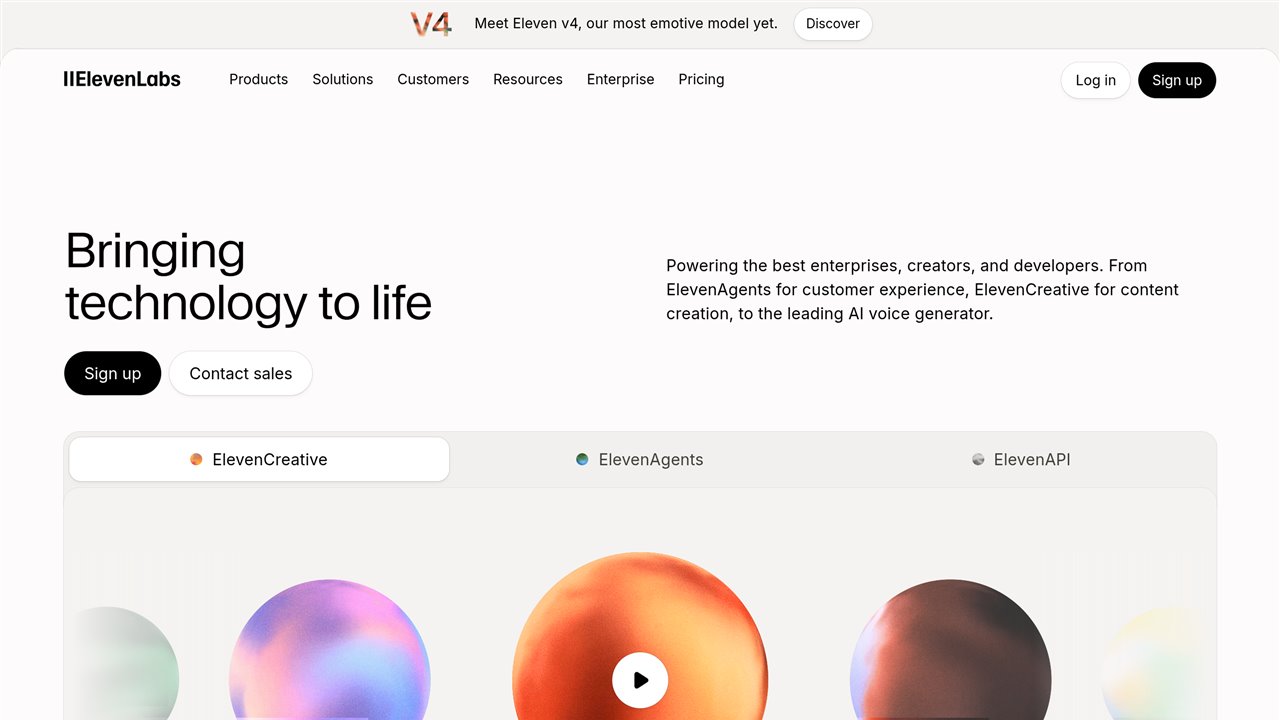
Short answer: ElevenLabs is the most capable voice generator you can buy with a card, and the sticker price is not the number that decides your bill. Credits are.
Creator, the plan most individuals land on, lists $22 a month for 121,000 credits on elevenlabs.io/pricing, read October 27, 2026. One pot of credits covers speech, music, dubbing and transcription, so whatever you spend on one is gone from the rest.
This review explains what a credit buys, how to work out how many you need before you pay, and which lines in the terms catch people out.
Every figure below was read on ElevenLabs' own pages on October 27, 2026, and no test of our own was run. Some links here are affiliate links; the reading came first, the link went in afterwards.
See ElevenLabs' current plans →
A credit is one character of speech
ElevenLabs bills in credits, and the pricing FAQ publishes the conversion for every product. Text to speech costs 1 credit per character on the V2 multilingual models, read October 27, 2026.
That makes the sum easy to do in your head. A minute of narration is roughly a thousand characters, which is why the comparison table prints Creator's 121,000 credits as about 121 minutes.
Everything else costs more per minute, and the gap is wide enough to change which plan you need.
- Text to speech — 1 credit per character, so about 1,000 credits a minute of narration.
- Speech to text — 330 credits a minute.
- Eleven Music — 900 credits a minute.
- Sound effects — 200 credits per generation.
- Voice changer and voice isolator — 1,000 credits a minute each.
- Dubbing — 2,000 a minute automatic with a watermark, 3,000 without, 5,000 for Dubbing Studio with one and 10,000 without.
The FAQ is blunt about the consequence. All products draw from one shared monthly pool, so using one leaves fewer credits for the others.
Two smaller rules sit in the same section. Credits are charged per generation request rather than per download, and a limited number of free regenerations may be available when the text and settings do not change.
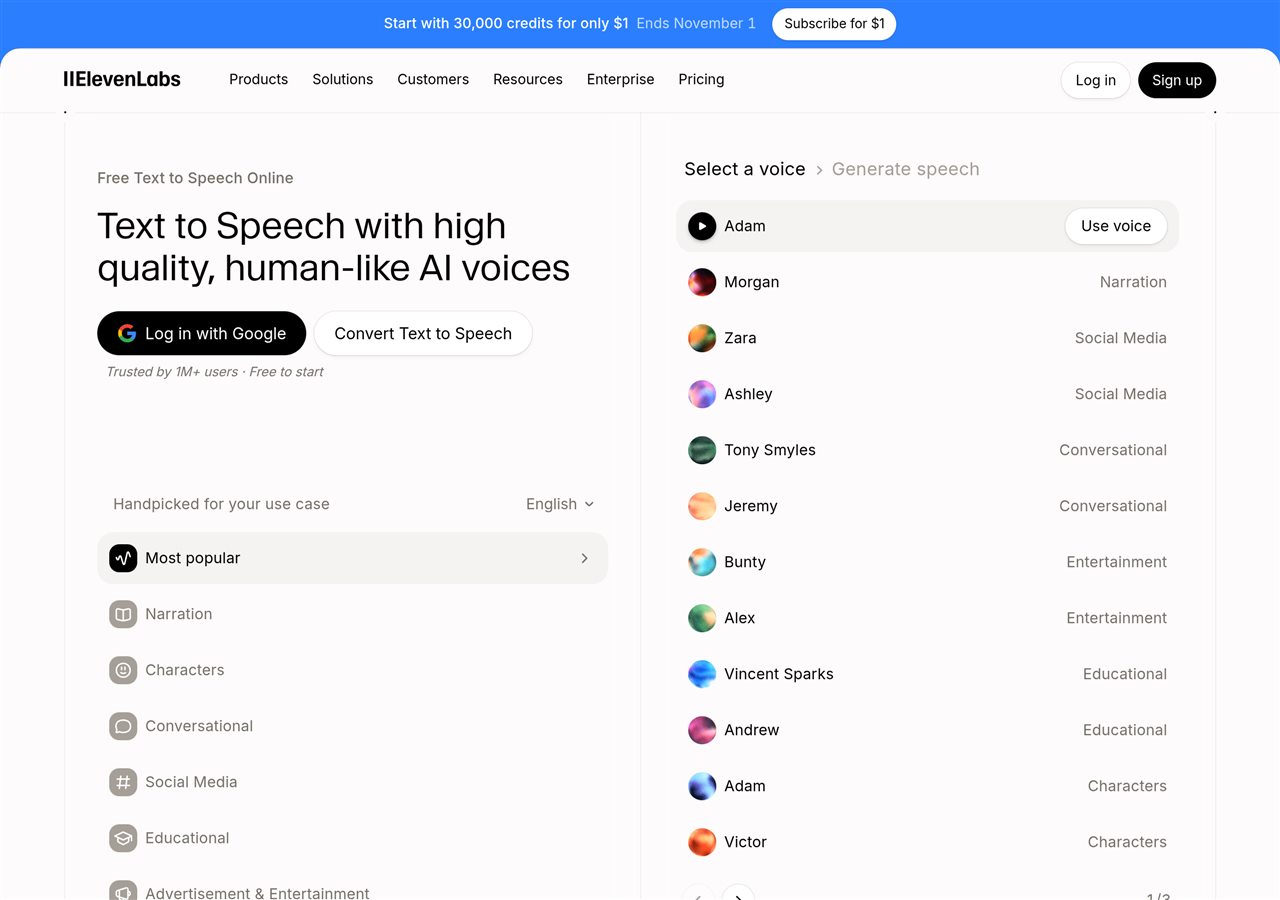
That page is the cheapest way to see the quality for yourself. It carries a claim of its own, "Trusted by 1M+ users," and does not say how many of those users pay anything.
If you are not sure how to brief the model in the first place, start with our note on how to ask an AI tool for what you want.
What each price gets you
Six published plans, and the jumps between them are large. These are the monthly-billing figures from the plan cards, read October 27, 2026.
- Free — $0 a month. 10,000 credits and 3 Studio projects. No commercial licence.
- Starter — $6 a month. 30,000 credits, commercial licence, instant voice cloning, 20 Studio projects and Dubbing Studio. A badge reading "Until Nov 1" offered a first month at $1.
- Creator — $22 a month. 121,000 credits and professional voice cloning. Badged "Popular," with a first month at $11.
- Pro — $99 a month. 600,000 credits, 192kbps audio and 44.1kHz PCM output via the API.
- Scale — $299 a month. 1.8M credits and 3 workspace seats, with team collaboration.
- Business — $990 a month. 6M credits, 10 seats and low-latency speech billed as low as 5 cents a minute.
- Enterprise — custom pricing. Adds DPA and SLA terms, HIPAA BAAs, custom SSO and priority support.
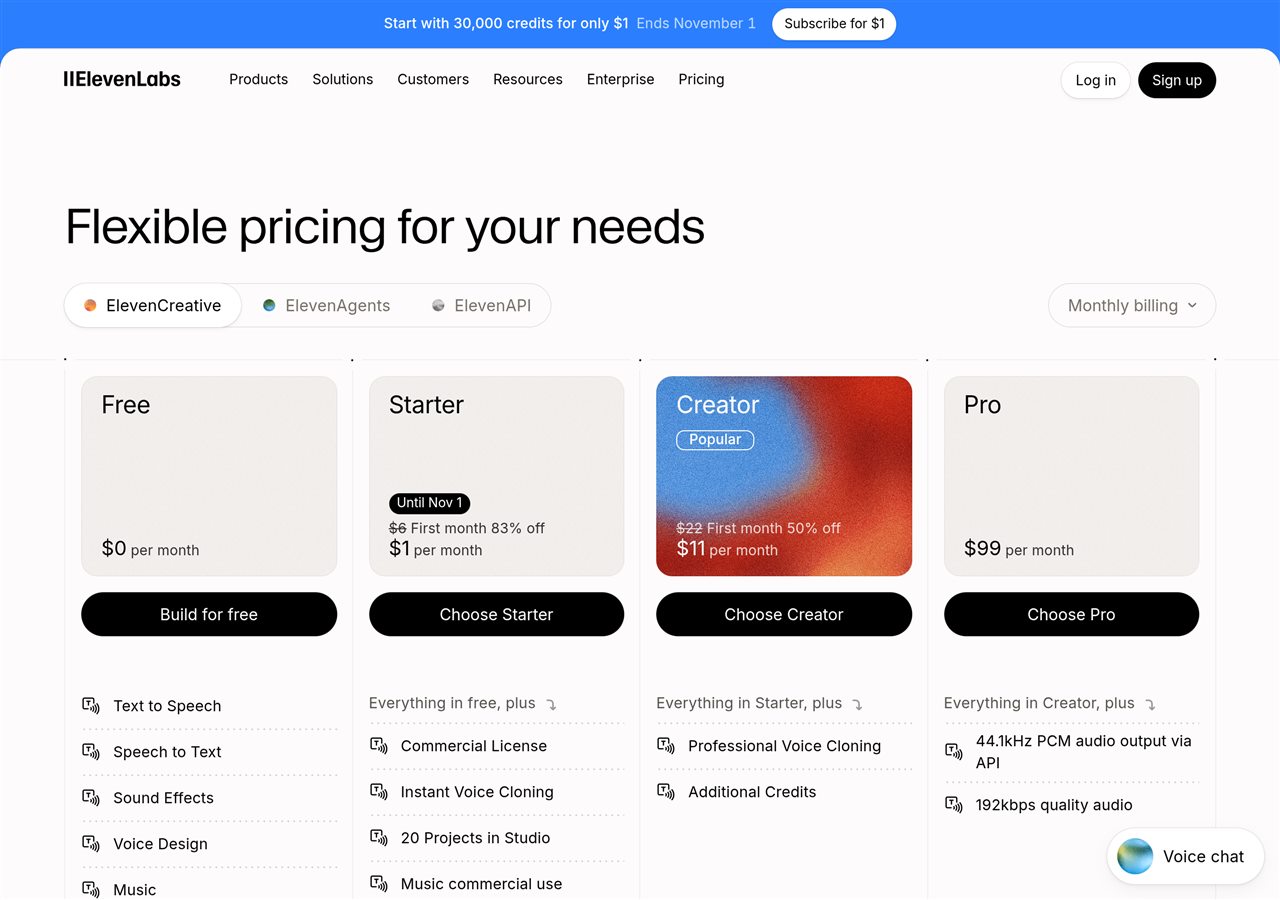
Annual billing is the plainest discount on the page. The FAQ states you pay for ten months, giving equivalent monthly rates of $5 Starter, $18.33 Creator, $82.50 Pro, $249.17 Scale and $825 Business.
Editorial arithmetic from those figures: Creator is $264 a year billed monthly against $220 billed annually, a difference of $44. The page also warns that prices exclude all taxes, levies and duties.
One free route is worth knowing about. The Startup Grants Program offers 12 months free and 33 million characters to startups building conversational agents, per the same page.
Check today's ElevenLabs pricing →
Work out your own number before you pay
The plan you need is a calculation, not a judgement call, and it takes about two minutes. Do it with your real workload rather than the one on the landing page.
- 1. Count the minutes. How many finished minutes of audio do you publish in a normal month?
- 2. Multiply by the credit cost of the product you will actually use: about 1,000 a minute for speech, 2,000 to 10,000 for dubbing.
- 3. Add a third for retries. Credits are charged per generation, so a take you reject still costs you.
- 4. Match the total to an allowance: 10,000 credits on Free, 30,000 Starter, 121,000 Creator, 600,000 Pro.
- 5. Check the overage rate before jumping a tier. Extra minutes run $0.36 on Free, $0.20 Starter, $0.18 Creator and $0.17 from Pro upward.
- 6. Decide monthly or annual last, once a month of real work has proved the number.
Two worked examples from those rates. A weekly ten-minute narrated video is roughly 40,000 credits a month, so Starter falls short and Creator has room to spare.
A single fifteen-minute client video dubbed without a watermark is around 150,000 credits. That one job exceeds Creator's whole allowance, which is the case for Pro rather than a cheaper rung.
The same habit applies to any subscription. Our guide on how to get your data out before you cancel is worth reading on day one, not on the day you leave.
The limits that decide whether a plan is enough
Price aside, two rows in the Compare plans table decide whether a tier works: how many voices you may keep, and how many jobs can run at once. All rows below were read October 27, 2026.
- Custom voice slots — 3 on Free, 10 Starter, 30 Creator, 160 Pro, 660 Scale, 2,200 Business.
- Professional voice clones — none until Creator, which gets 1; Scale has 3 and Business 10.
- Concurrent requests — 2, 3, 5, 10, 15 and 25 across the six plans.
- Languages — 74 on every tier, including the free one.
- Audio quality — 128kbps at 44.1kHz on Free and Starter, 128 and 192kbps from Creator upward.
Rollover softens a quiet month, within limits. Unused credits roll over for up to two months, capped at twice the monthly quota, so a balance tops out at three times it.
The catch is in the same answer. Rollover needs an active paid subscription, does not apply to the Free plan, and downgrading or cancelling forfeits what is left at the end of the cycle.
Transcription is the one place where a cheaper specialist often wins. For meetings in particular, weigh 330 credits a minute against Otter.ai, Fireflies.ai and tl;dv.
What the billing terms say, in plain words
The terms of use are stricter than the pricing page reads, and they explain most of the public complaints. These are the clauses to know before the card goes in.
On refunds the document says "All sales are final," with refunds offered at the company's sole discretion. Cancelling mid-term keeps access to the end of the period and returns nothing already paid.
Subscriptions renew automatically at the then-current price. If prices change, you have to cancel at least seven days before the new rate takes effect, or the renewal happens at it.
Prepaid top-up credits are harsher. They expire twelve months after purchase unless stated otherwise at the time of purchase, and they sit outside the ordinary rollover cap.
The ownership clause is the reassuring one. You keep all rights in your Output, with paid plans permitting commercial use and free accounts limited to non-commercial purposes under the Prohibited Use Policy.
Before any generated audio reaches a client, apply the scepticism you would apply to text. Our guide on how to check an AI answer before you pass it on covers the habit.
Where the public complaints cluster
Public feedback is poor and oddly split. Trustpilot showed a TrustScore of 3.0 from 1,208 reviews when the page was read on October 27, 2026.
The distribution carries the message better than the average does: 47% five-star, 5% four-star, 3% three-star, 6% two-star and 39% one-star. Almost nobody sits in the middle.
The one-star reviews cluster on billing rather than on audio quality — cancellations that did not take, renewals nobody expected, credits removed, support forms left unanswered.
The five-star reviews praise the voices, and often the support that did reply. Both experiences look real; which one you get appears to depend on whether billing goes wrong.
Read that as a billing risk rather than a product risk. Pay monthly until the workload is proven, cancel inside the account rather than by email, and keep the receipt.
Who it fits, and who should skip it
ElevenLabs suits people who publish audio often enough to spend a monthly allowance. The fit falls away quickly when the work is occasional.
- Course and audiobook producers. Creator's 121,000 credits are about 121 minutes of narration a month.
- Podcasters who edit the script rather than the tape. Studio projects start at 3 on Free and 20 on Starter.
- Video freelancers localising client work. Automatic dubbing and Dubbing Studio both begin on Starter at $6 a month.
- Anyone selling the output. The commercial licence starts on Starter, the cheapest paid rung on the page.
- Developers wiring voice into a product. 44.1kHz PCM output via the API arrives on Pro at $99 a month.
- Anyone who needs a voice over slides or video. Pair it with Gamma for decks or Descript for editing.
Three readers should close this tab now.
- You want commercial rights for nothing. The terms limit free accounts to non-commercial purposes.
- Your audio work is occasional. Credits survive two months at most, and cancelling forfeits the balance.
- You expect refund cover. "All sales are final" is the stated policy, and billing is exactly where the one-star reviews land.
Buy it if you publish every week, if you sell the output, or if you need breadth of languages — the table lists 74 on every tier, free included.
Skip it if dubbing is the main job on a small plan. By our arithmetic, even Creator's allowance covers only about twelve watermark-free Dubbing Studio minutes a month.
Writing the script is a separate job from voicing it. Grammarly, ProWritingAid and Wordtune all appear in our guide to everyday AI writing assistants.
Bottom line
ElevenLabs is the obvious pick if you ship audio regularly, and Creator at $22 a month is the rung where professional voice cloning and a usable allowance both appear.
The reservations are specific rather than general: a 39% one-star share on Trustpilot, "all sales are final" in the terms, and credits that vanish on the way out.
None of that argues against signing up. It argues for starting free, counting your minutes, paying monthly until the number is proven, and putting the renewal date in the calendar.
Start on ElevenLabs' free plan →
Related reading on this site: the guide to AI meeting note-takers, the guide to AI presentation tools, the Otter.ai and Fireflies.ai comparison, and our note on writing a prompt that gets a usable first draft.
Frequently asked
Does ElevenLabs have a free plan?
Yes. Free is $0 a month with 10,000 credits and 3 Studio projects, checked October 27, 2026. It carries no commercial licence, and the terms limit free accounts to non-commercial purposes.
How much does ElevenLabs cost a month?
Monthly billing ran $6 Starter, $22 Creator, $99 Pro, $299 Scale and $990 Business on October 27, 2026. Annual billing charges ten months instead of twelve, so Creator works out at $18.33 a month.
How many minutes do 121,000 credits buy?
About 121 minutes of text to speech, per the Compare plans table checked October 27, 2026. Other products cost more: 330 credits a minute for transcription, 900 for music, and 2,000 to 10,000 for dubbing.
Can I use ElevenLabs audio commercially?
Only on a paid plan. The commercial licence begins on Starter at $6 a month, and the terms limit free accounts to non-commercial purposes. The same document says you keep all rights in your Output.
Do unused ElevenLabs credits roll over?
Yes on paid plans, for up to two months, with the balance capped at three times the monthly quota. Rollover does not apply to the Free plan, and downgrading or cancelling forfeits what is left.
Can I get a refund from ElevenLabs?
Not as a right. The terms state "All sales are final," with refunds at the company's sole discretion. Prepaid top-up credits are non-refundable and expire twelve months after purchase.
Sources
- ElevenLabs pricing page (plan prices, credits, Compare plans table, pricing FAQs) - checked October 27, 2026
- ElevenLabs homepage (products, models, voice and language claims) - checked October 27, 2026
- ElevenLabs Text to Speech page - checked October 27, 2026
- ElevenLabs terms of use (refunds, renewal, prepaid credits, commercial use, output rights) - checked October 27, 2026
- Trustpilot reviews of elevenlabs.io (TrustScore and star distribution) - checked October 27, 2026