Quo review: what its AI actually does, in plain English
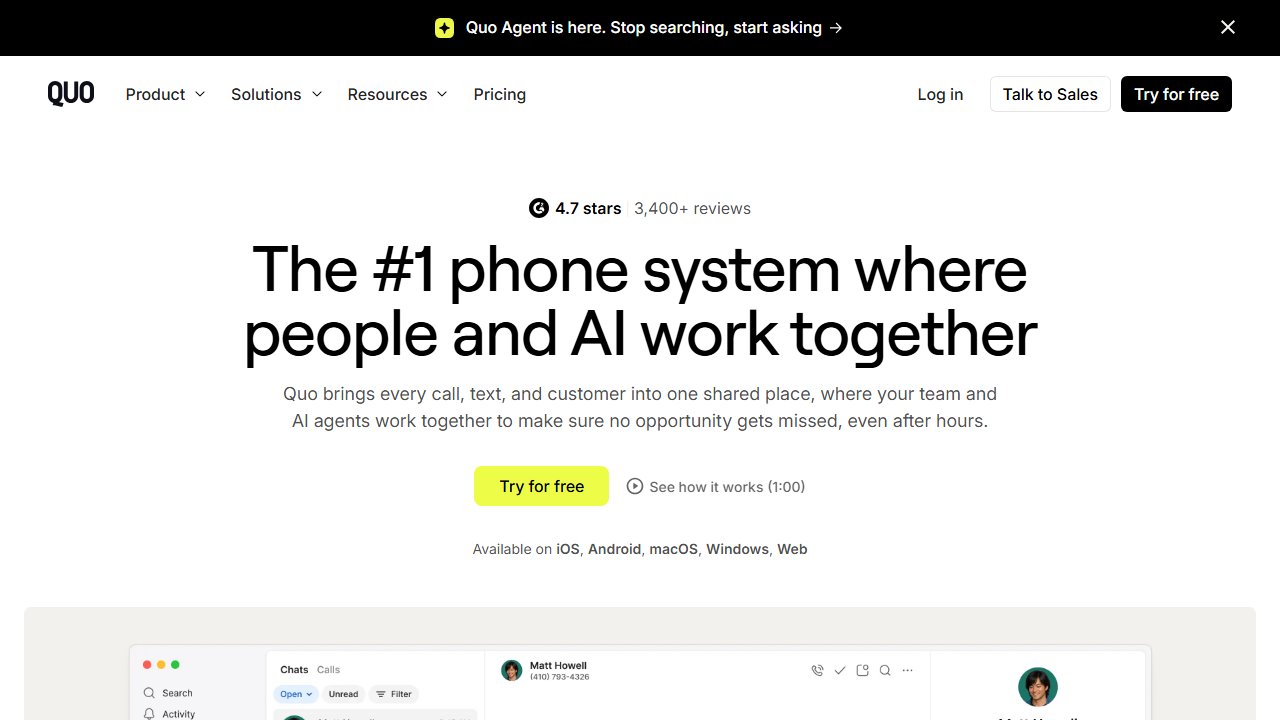
Short answer: Quo is a business phone system — the product sold as OpenPhone until September 2025 — and its AI is four separate things with four separate rules.
Read on November 2, 2026, the cheapest plan is $15 per user per month, billed annually at $180, with a seven-day trial and no free tier.
Sona, the AI that answers your calls, sits on every plan but runs on a meter: 1,000 automation credits, which the pricing page converts to 10 calls.
This guide explains which AI you get at no extra charge, which one adds a second bill, and what the vendor does not publish. Every figure comes from quo.com and Trustpilot, read on November 2, 2026. No test of our own was run.
Some links here are affiliate links. The reading came first, and the prices below are the vendor's, not ours.
Quo is OpenPhone renamed, with an AI layer on top
Quo is the product that used to be sold as OpenPhone. The company announced the change on September 23, 2025, alongside $105 million in growth financing.
Its words at the time: the rebrand "isn't about changing the product you already know and trust." The phone part has stayed ordinary, and that is a compliment.
App-based numbers for iOS, Android, macOS, Windows and the web. One shared inbox per number. Voicemail transcripts on every plan, per the pricing page read November 2, 2026.
What makes this an AI story is the layer above that. The homepage headline, read the same day, is "The #1 phone system where people and AI work together."
The rebrand is still unfinished in places. The Sona page says calls are "recorded and organized right in your OpenPhone workflow." Cosmetic, but useful to know before you search the help centre.
If you have never briefed an AI tool properly, our note on how to ask an AI tool for what you want is the right warm-up before any of this.
The AI here is four products, not one
This is the part no pricing page spells out. "AI" at Quo means four different things, on different plans, with different costs attached.
- Sona — the agent that answers inbound calls. Listed on every plan card, but metered in credits. It is the only piece that can add a bill of its own.
- Quo Agent — the assistant that answers your questions about your own business. In open beta, free while that lasts, available on every plan.
- AI call summaries and transcripts — Business plan and up. Bulleted discussion points per speaker, a list of action items, and a searchable time-stamped transcript.
- The MCP connector — Claude and ChatGPT. "Available with every Quo plan," so you can ask your own assistant about calls and texts without opening Quo.
Quo Agent is the newest and the easiest to try. Its product page says it is "free to use while it's in open beta," runs on web and desktop but "not yet" on mobile, and asks for approval before sending anything.
Free betas are not promises. The same page adds: "We'll give advance notice well before anything changes." That is a vendor telling you the price is not settled.
Only one of the four is likely to move your invoice. Working out which is the whole reason to read a pricing page slowly instead of a feature list quickly.
What each plan costs, and where the AI sits
The plan cards open on the Yearly tab. Read November 2, 2026, the prices and the saving badges reconcile with each other, which is not true of every pricing page.
- Starter — $15 per user per month, billed annually at $180, badged "Save $48/year"; $19 month to month. Includes one new or ported number per user, US and Canada calling and messaging, voicemail transcripts, the Quo API, email support, the Sona AI agent, the ChatGPT and Claude MCP, and 1,000 free automation credits.
- Business — $23 per user per month, billed annually at $276, badged "Save $120/year"; $33 month to month. Adds AI call summaries and transcripts, group calling, custom ring orders, call transfers, HubSpot and Salesforce integrations, phone menus, analytics, auto call recording and live chat support.
- Scale — $35 per user per month, billed annually at $420, badged "Save $144/year"; $47 month to month. Adds AI call tags, dedicated onboarding, priority live chat and email support, and inbound phone support, which the card marks "New".
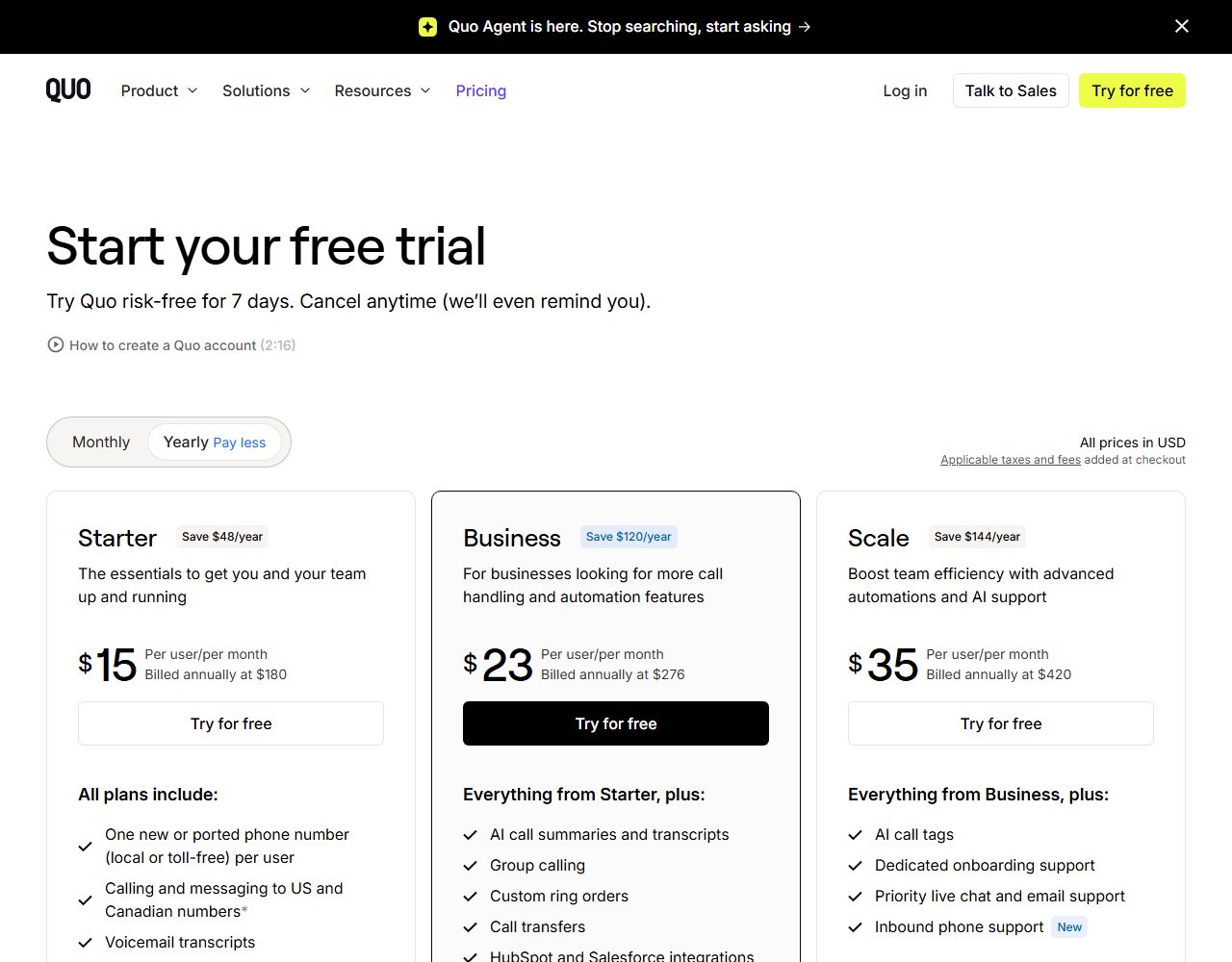
Editorial arithmetic from that card: Starter at $19 month to month is $228 a year, against $180 billed annually. The $48 gap is exactly what the badge claims. The other two badges check out the same way.
Two lines on the same page are worth more than they look: "All prices in USD" and "Applicable taxes and fees added at checkout." The headline is not the bill.
The add-ons sit lower down the page, and they are where a phone bill usually grows.
- Additional phone numbers — $5 a month each.
- Carrier review and setup — $19.50, one time, the screening that US carriers want before they will deliver business texts reliably.
- Monthly messaging fee — $1.50 to $3 a month, to keep that standing.
- Automated SMS — $0.01 per outgoing text message.
Editorial arithmetic again: one person on Starter who texts US customers pays $180, plus $19.50 once, plus $18 to $36 a year in messaging fees. Call it $217 to $236 in year one, before any Sona overage.
The free route is a trial, not a tier: "Try Quo risk-free for 7 days. Cancel anytime (we'll even remind you)." Seven days is the whole of it.
Sona is the only AI here with a meter on it
Sona appears on every plan card, and that phrasing hides the shape of the cost. Quo prices it in automation credits, at 100 credits per call.
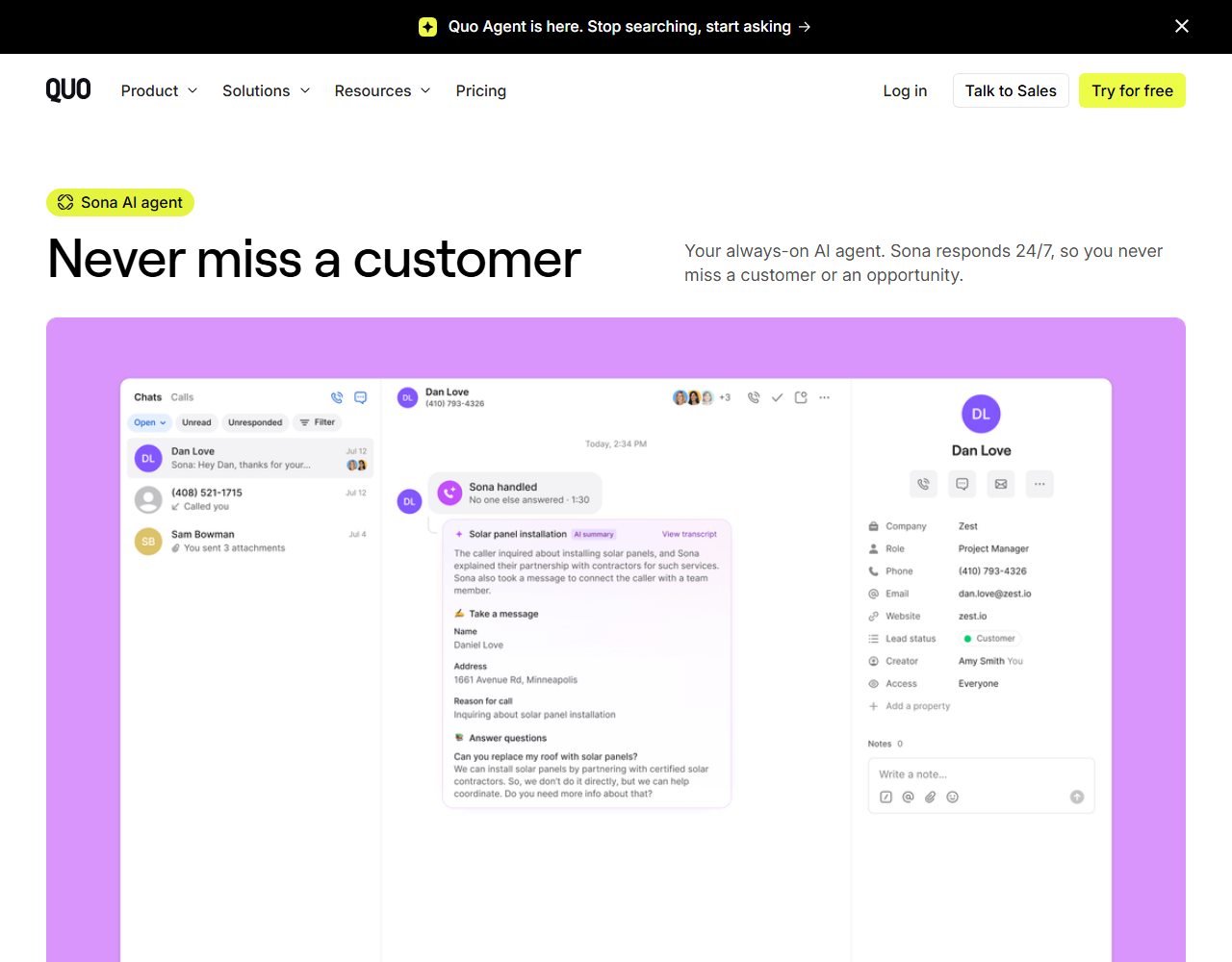
Every plan carries 1,000 free automation credits, which the pricing page converts to 10 calls. The page does not state whether that allowance resets; the Sona FAQ frames it as roughly 10 calls a month.
Past the allowance you pay per call or buy a bundle. The table, read November 2, 2026:
- Included — 1,000 credits, 10 calls, then $1.00 per call.
- $25 a month — 4,000 credits, 40 calls, $0.75 overage.
- $49 a month — 10,000 credits, 100 calls, $0.65 overage.
- $99 a month — 25,000 credits, 250 calls, $0.55 overage.
- $199 a month — 60,000 credits, 600 calls, $0.45 overage.
Editorial arithmetic from those two tables: a solo operator on Starter who needs 40 answered calls a month pays $180 a year for the line and $300 a year for the Sona bundle. The AI costs more than the phone.
That is not a criticism. It is the number to carry into the trial week, because an answering service staffed by people costs considerably more.
The limits are published, which is more than most AI vendors manage. Sona answers inbound calls only, works inside Quo only, and supports English, Spanish and French.
One limit matters on a live line: "Sona cannot detect or switch between languages mid-call." If your callers switch languages, your expectations have to switch first.
What it does during a call is modest and clear: greet callers, answer questions from details you have typed in, capture messages, send an SMS with a link, and transfer to a teammate.
Two trial wrinkles. You cannot buy Sona during the Quo free trial — the FAQ says a paid plan comes first. A separate seven-day Sona trial exists for admins and owners on Stripe billing who have not used one before.
Treat its summaries the way you would treat any model output. Our guide on how to check an AI answer before you pass it on matters doubly when the source was a stranger's phone call.
Start Quo's 7-day free trial →
The Claude and ChatGPT connector is the quiet win
The MCP connector is the feature least likely to come up in a sales call and most likely to save an hour a week. The page states it plainly: "Available with every Quo plan."
What it does, in the vendor's words: "surface call and text insights, send texts to your customers, and manage contact data, right from chat."
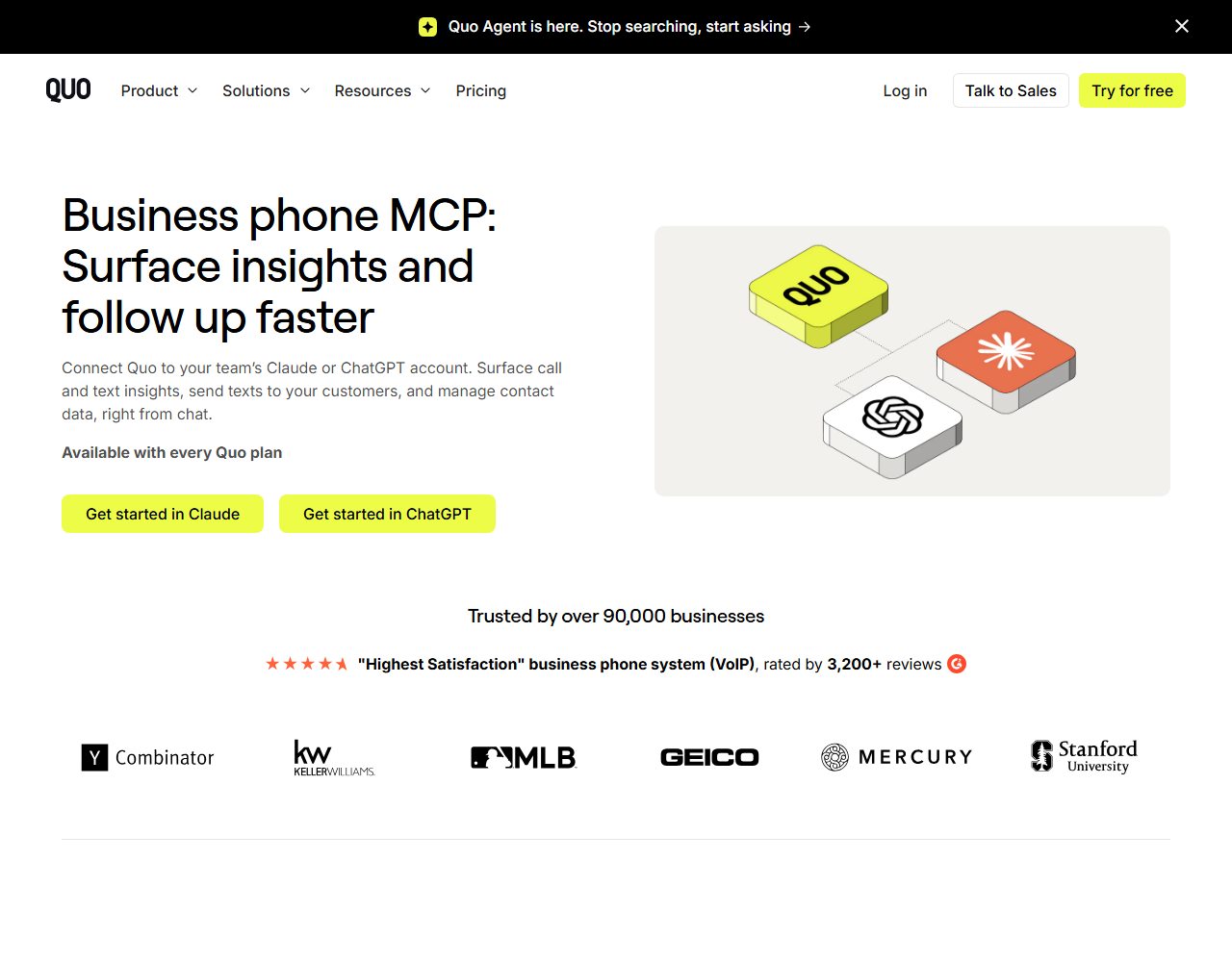
Setup is a connector, not a build. In Claude you open Settings, then Connectors, find Quo, click Connect and then Allow. In ChatGPT you open Settings, then Apps, find Quo and sign in.
The page is blunt about the skill required: "If you can log in to Quo, you can activate this." No coding step is listed on either path.
Two guardrails are stated on that page. "Before sending a text or creating a contact, your AI assistant asks for your approval," and "Call and text data is not used to train AI models."
One cost is easy to miss: "sending texts with MCP uses Quo API messaging credits." Asking questions is free. Acting on the answers is not.
What you get back is mostly a function of what you ask. How to write a prompt that gets a usable first draft is the habit worth borrowing before you point an assistant at a month of call transcripts.
Quo also lists an integration with Fireflies.ai, so meeting notes and call notes can land in one place. Our guide to AI meeting note-takers covers the alternatives, including Otter.ai.
What Quo publishes about your data, and what it does not
The security page is specific where it can be: SOC 2 Type II certification, HIPAA compliance with Business Associate Agreements available, TLS 1.2+ in transit, AES-256 at rest, plus GDPR and CCPA. Hosting is AWS and Google Cloud.
On leaving, it is direct: "Export your conversations, contacts, and call history whenever you want." On selling, it is shorter: "We don't sell your data. Ever."
One claim has nothing published beside it. "We maintain 99.999% uptime with redundant systems and automatic failover" is the vendor's own figure, with the status page linked separately in the footer.
The terms are blunter than the marketing. "All Fees paid are non-refundable." Subscriptions renew automatically unless either party gives thirty days' notice before the term ends.
The trial carries its own clause: the service under the free trial is provided "AS-IS", without warranty, and Quo "shall not have any obligation to provide any support" during it.
Which makes the exit plan a day-one job, not a last-day one. Our guide on how to get your data out before you cancel sets out the order to do it in.
The real exit cost is the number, not the files. A ported-in number has to be ported out again, and that is a conversation with two carriers rather than a button in a settings page.
What reviewers report, and where the complaints land
Public feedback is good on average and unusually split underneath. Trustpilot, under the openphone.co listing, showed a 4.2 TrustScore from 1,122 reviews when the page was read on November 2, 2026.
The distribution is the part worth reading: 72% five-star, 5% four-star, 2% three-star, 2% two-star and 19% one-star. Almost nobody lands in the middle.
Recent one-star titles cluster on the line and the support desk rather than on the AI.
Three dated October 27 and 28, 2026 read "SERVICE gets disrupted as and when it wishes", "No humans to speak to on the phone" and "Very bad customer service, flaky text service".
The vendor's own numbers are better, and they are different numbers. The homepage shows "4.7 stars | 3,400+ reviews" and "Powering conversations for 90,000+ businesses", read November 2, 2026.
The MCP page carries a third: a "Highest Satisfaction" business phone system badge for VoIP, "rated by 3,200+ reviews", beside a G2 mark. None of the three is the Trustpilot figure, and that is normal.
Read the split as a shape rather than a verdict. It fits a product that works well until the connection or the backend does not. Keep a second way to be reached either way.
Who it fits, and who should skip it
Quo suits a small team whose missed calls cost real work and whose people already live in Claude or ChatGPT. The fit weakens quickly as calls leave North America.
- A solo operator still handing out a personal mobile number. Starter is $180 a year for one number, one inbox and voicemail transcripts.
- Anyone losing calls after hours. Sona answering 10 calls a month at no extra charge is the clearest free value on the cheapest card.
- Teams already asking Claude or ChatGPT questions daily. The MCP connector is on every plan and takes four clicks to switch on.
- Businesses that record and review calls. AI summaries, action items and time-stamped transcripts start on Business at $23 per user a month.
- Front desks working in English, Spanish or French. Sona covers those three, with the mid-call switching caveat above.
- Teams already fielding conversations on the web. Pair it with Chatbase or Crisp; our Tidio and Crisp comparison covers that side of the inbox.
Three readers should close this tab now.
- You want a free number. There is none. A seven-day trial is the whole of the free access, and Sona cannot be bought during it.
- Your calls are mostly international. US and Canada are covered subject to the Fair Usage Policy; everywhere else is an add-on.
- You wanted an AI that makes calls. The FAQ is explicit: "Sona currently answers only inbound calls."
Buy it if missed calls cost you work, if your team already asks an AI assistant questions all day, or if you would otherwise pay separately for an answering service.
Skip it if you only wanted transcripts of meetings. Fireflies.ai, Otter.ai and tl;dv do that without a phone plan underneath.
Bottom line
Quo is a competent business line at $180 a year for one person, with an AI layer that is more honest about its limits than most. Published limits beat polished claims.
The reservations are about the meter and the middle. Sona past 10 calls a month can cost more than the phone plan, and 19% of Trustpilot reviewers rate the service one star.
Neither argues against signing up. Both argue for counting your real monthly call volume during the seven-day trial, confirming the figure at checkout, and putting the renewal date in a calendar.
Related reading on this site: our lemlist review for the outbound side of the same job, the ElevenLabs review for synthetic voice, and Tidio for the chats that arrive rather than ring.
Frequently asked
Does Quo have a free plan?
No. The pricing page offers a seven-day free trial on all three plans, with "cancel anytime (we'll even remind you)." After that the cheapest entry is Starter at $15 per user per month, billed annually at $180, checked November 2, 2026.
Is Quo the same thing as OpenPhone?
Yes. OpenPhone renamed itself Quo on September 23, 2025, the same day it announced $105 million in growth financing, and said the product itself was not changing. Some pages still read "OpenPhone" as of November 2, 2026.
How much does Sona cost after the free credits?
$1.00 per call once the included 1,000 credits, which the page converts to 10 calls, run out. Bundles run from $25 a month for 4,000 credits to $199 for 60,000, with overage falling from $0.75 to $0.45 per call.
Which Quo plan includes AI call summaries?
Business, at $23 per user per month billed annually at $276, checked November 2, 2026. It generates bulleted discussion points per speaker, a list of action items and a searchable time-stamped transcript, in English, seconds after a recorded call ends.
Can I use Quo from Claude or ChatGPT?
Yes. The MCP connector is "available with every Quo plan" and works with both. It surfaces call and text insights and can send texts, after asking your approval. Sending texts consumes Quo API messaging credits.
Does Quo train AI models on my calls?
The MCP page states "Call and text data is not used to train AI models," and the security page states "We don't sell your data. Ever." Both lines were read on November 2, 2026.
What does Quo cost on top of the subscription?
Four add-ons were listed on November 2, 2026: extra phone numbers at $5 a month each, a one-time $19.50 carrier review and setup fee, a $1.50 to $3 monthly messaging fee, and $0.01 per outgoing automated text.
Sources
- Quo pricing page (plan cards, billing toggle, add-ons, Sona credit table, trial terms) - checked November 2, 2026
- Quo homepage (positioning, 4.7 stars / 3,400+ reviews and 90,000+ businesses claims, platforms) - checked November 2, 2026
- Sona AI agent page (what it does, languages, inbound-only limit, trial rules, FAQ) - checked November 2, 2026
- Quo Agent product page (open beta, free while in beta, web and desktop only, approval step) - checked November 2, 2026
- Business phone MCP page (Claude and ChatGPT setup, approval guardrail, no model training, messaging credits) - checked November 2, 2026
- AI call summaries feature page (what the summary contains, Business plan, English only) - checked November 2, 2026
- Quo security page (SOC 2 Type II, HIPAA, encryption, 99.999% uptime claim, data export) - checked November 2, 2026
- Quo Terms of Service (non-refundable fees, automatic renewal, free trial AS-IS clause) - checked November 2, 2026
- "The next chapter" — OpenPhone to Quo rebrand announcement and $105 million financing - checked November 2, 2026
- Trustpilot reviews for openphone.co (TrustScore, review count, star distribution, recent reviews) - checked November 2, 2026