
Chatbase
An AI support agent trained on your own content, metered in message credits rather than seats
Scored on the published rubric, from documentation, pricing and verified user reports.
Best for: Sites that want one well trained AI agent on their own documents and already have somewhere for humans to reply.
Verdict
Chatbase is not a help desk. It builds one AI agent on your own content and bills you for the replies that agent sends.
The unit is a message credit. Hobby includes 700 a month, Basic 4,000 and Business 15,000, per the plan comparison table read on October 25, 2026.
The catch is that one reply does not always cost one credit. The documentation sets the rate by model, from one credit to five. A deep reasoning model therefore cuts your monthly allowance by a factor of five.
Two other limits matter more than the headline price. All three self serve plans include exactly one AI agent, and all three cap training content at 40 MB per agent.
This is a documentation review. We read the pricing page, the price catalogue inside its HTML, the published FAQ answers and two documentation pages. No paid account was opened.
Visit Chatbase
We have no affiliate relationship with this vendor. Link goes to the official site.
Where it is strong
- Monthly and yearly prices are both published in the page, and the 20% yearly discount checks out
- Credit cost per model is documented, so the real capacity of a plan can be worked out before buying
- The vendor states plainly that customer data is not used to train or fine-tune any model
- GDPR, SOC 2 Type II and HIPAA are all named on the pricing page
- Advanced models from seven providers are available on every self serve plan, not just the top one
Where it falls short
- Hobby, Basic and Business all include just one AI agent; extra agents are $300 per agent per year
- Training content is capped at 40 MB per agent on all three self serve plans
- Unused subscription credits do not carry over to the next month
- Hobby has no API access and none of the help desk integrations
- Removing the Powered By Chatbase badge is a $1,188 a year add-on
At a glance
| Starting price | $40/mo monthly, or $32/mo billed yearly |
|---|---|
| Pricing note | From $40/mo monthly, or $32/mo billed yearly, for 700 message credits (pricing page HTML, checked October 25, 2026) |
| Free plan | No; each paid plan opens with a 7 day trial |
| Message credits | 700 (Hobby), 4,000 (Basic), 15,000 (Business) per month |
| AI agents included | 1 on all three self serve plans |
| Training content | 40 MB per agent on all three self serve plans |
| Workspace seats | 2 (Hobby), 3 (Basic), 5 (Business) members |
| Annual billing | Yearly 20% off, shown as $384, $1,440 and $4,800 a year |
| Credit add-on | $40 per 1,000 auto-recharge credits, which do not expire |
What Chatbase actually is
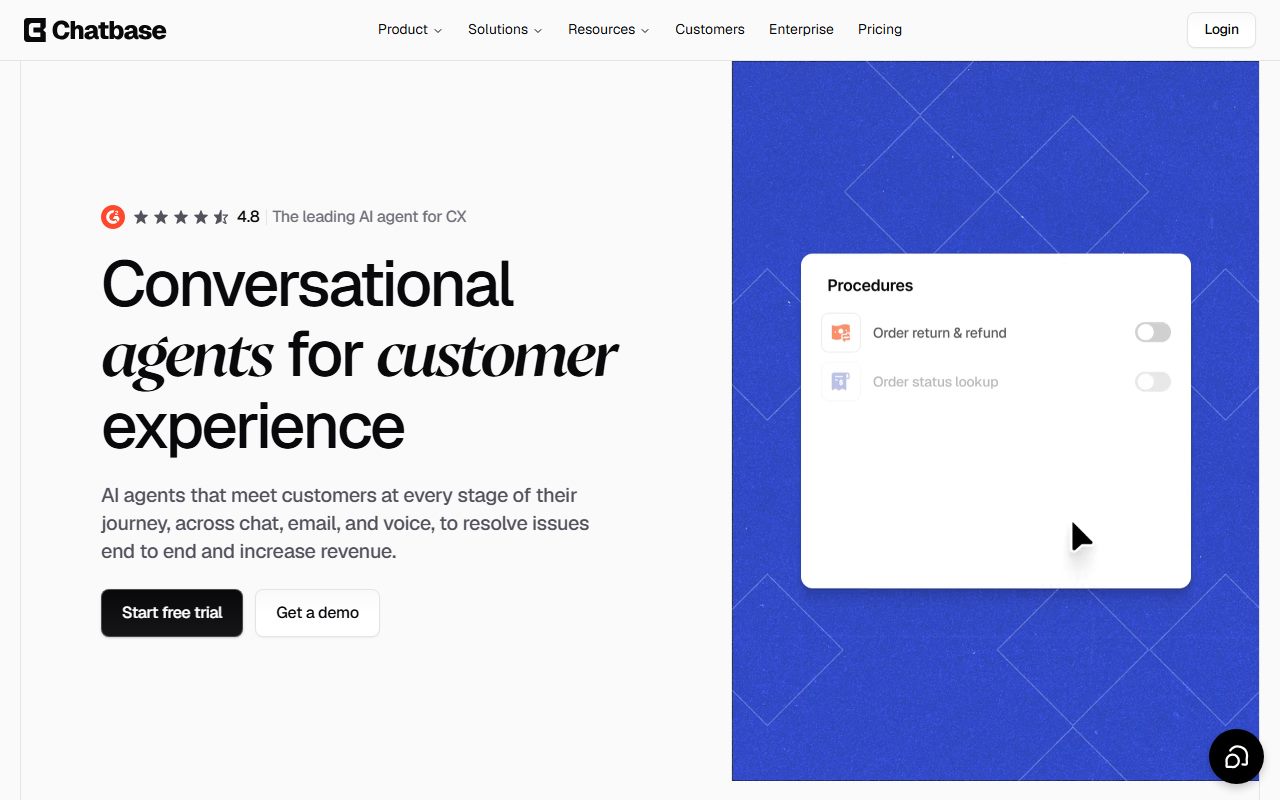
Chatbase is an agent builder, not a support inbox. You point it at your website, documents and help centre, and it answers questions from that material.
Everything else on the pricing page follows from one unit: the message credit. Credits pay for the replies your agent sends to customers.
That makes the product easy to price and easy to underestimate. A plan's real capacity depends on which model you pick, not only on the credit number.
Who Chatbase is best for
The shape of the product suits a narrow job done well, rather than a whole support department.
- Sites with a well written help centre that want it answered automatically
- Teams that already pay for a help desk and want AI in front of it
- Shops on Shopify, WordPress, WhatsApp, Messenger or Instagram, all included from Hobby up
- Operations with a compliance checklist, since SOC 2 Type II and HIPAA are named
- Anyone who wants the credit maths published rather than hidden
Who should skip it
Two kinds of buyer will outgrow the self serve plans quickly, and one will never fit.
- Agencies or multi brand sites that need several agents, at $300 per extra agent per year
- Teams looking for a shared human inbox in the same bill
- Documentation heavy products whose material exceeds 40 MB of extracted text per agent
How the pricing is structured
Three independent readings of the same page agree, which is rarer than it should be. The visible cards, the price catalogue inside the page HTML and the structured data block all give the same monthly figures.
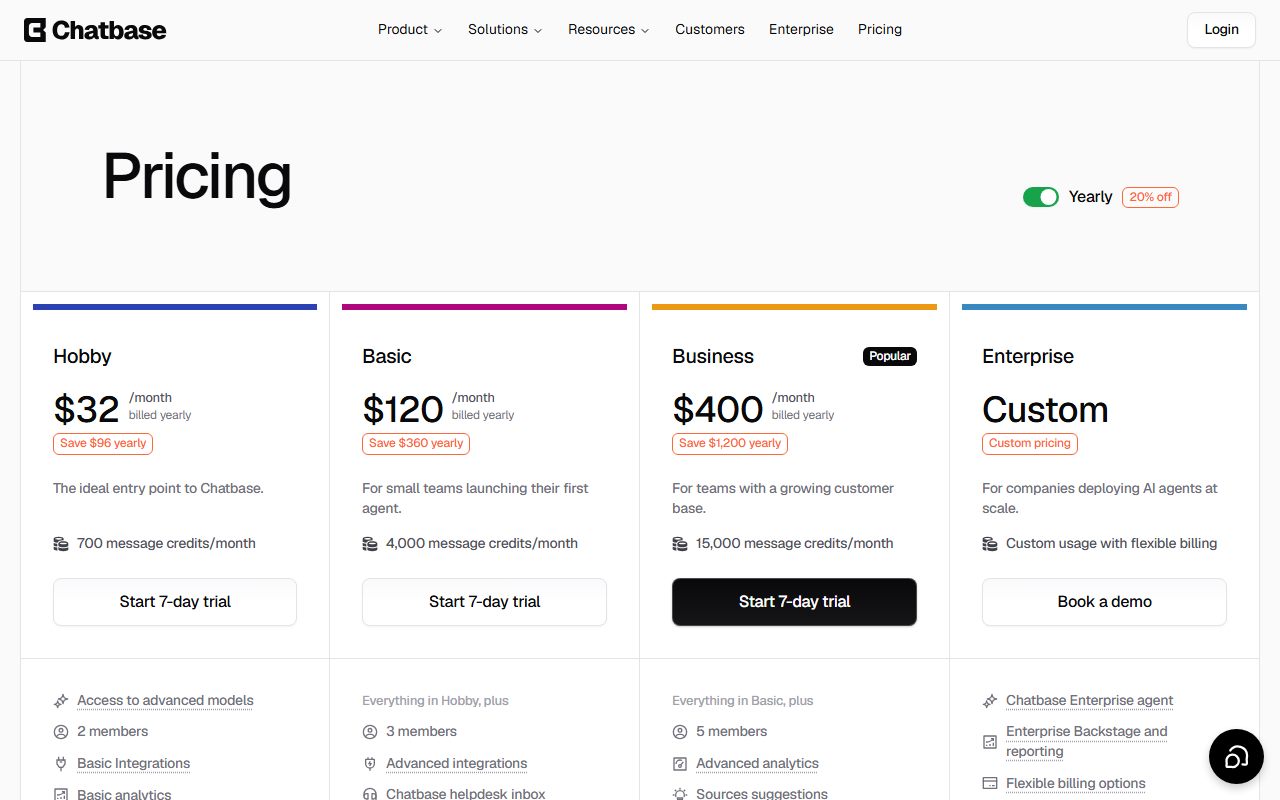
Hobby is $40 a month. Basic is $150. Business is $500. Enterprise is quoted.
The yearly totals in the catalogue are $384, $1,440 and $4,800. Divided by twelve those give $32, $120 and $400 a month, which is exactly what the cards display under the yearly toggle.
The toggle is labelled Yearly 20% off. Twelve months of Hobby at $40 is $480, and $480 less $384 is $96, matching the page's own Save $96 yearly line. Those checks are ours.
There is no free tier. Each paid self serve plan opens with a 7 day trial instead.
The four add-ons are where the bill grows
The add-on block sits below the plan cards and is easy to skim past. It deserves a slow read, because three of the four are priced per year.
- Auto-recharge credits: $40 per 1,000 message credits, and these credits do not expire
- Remove the Powered By Chatbase badge: $1,188 a year
- Extra agents: $300 per AI agent per year
- Extra storage: $300 per 10 MB per year, up to 40 MB more per agent
What a message credit really buys
This is the most important paragraph on the page, and it is not on the pricing page at all. The model comparison in the documentation sets the credit cost per reply.
One credit covers Auto, GPT-6 Luna, Claude 5.5 Haiku and, per the documentation, all other models not named in the higher tiers.
Two credits covers a long list including GPT-6.1 Sol, Claude 5.5 Sonnet and Gemini 3.8 Flash. GPT-5.5 costs four credits. Claude 5.5 Opus costs five.
So Hobby's 700 credits are 700 replies on a one credit model, or 140 replies on Claude 5.5 Opus. The same plan can be generous or tiny depending on one dropdown.
The API reference adds that voice minutes also consume message credits. Any plan with voice turned on should be sized with that in mind.
How the credit meter resets
Subscription credits renew at the start of each calendar month, whatever date you subscribed on. Chatbase gives the example of subscribing on 15 March and renewing on 1 April.
Unused subscription credits do not carry over. That is stated in the published FAQ and it is a real cost for a seasonal business.
Auto-recharge credits behave differently. They are added when your balance falls under a threshold you set, and they do not expire.
If you run out entirely, the FAQ says the agent displays a message telling the visitor it is unavailable. That is a visible failure on your own website, so the auto-recharge threshold is worth setting on day one.
Ease of use: what the score is built from
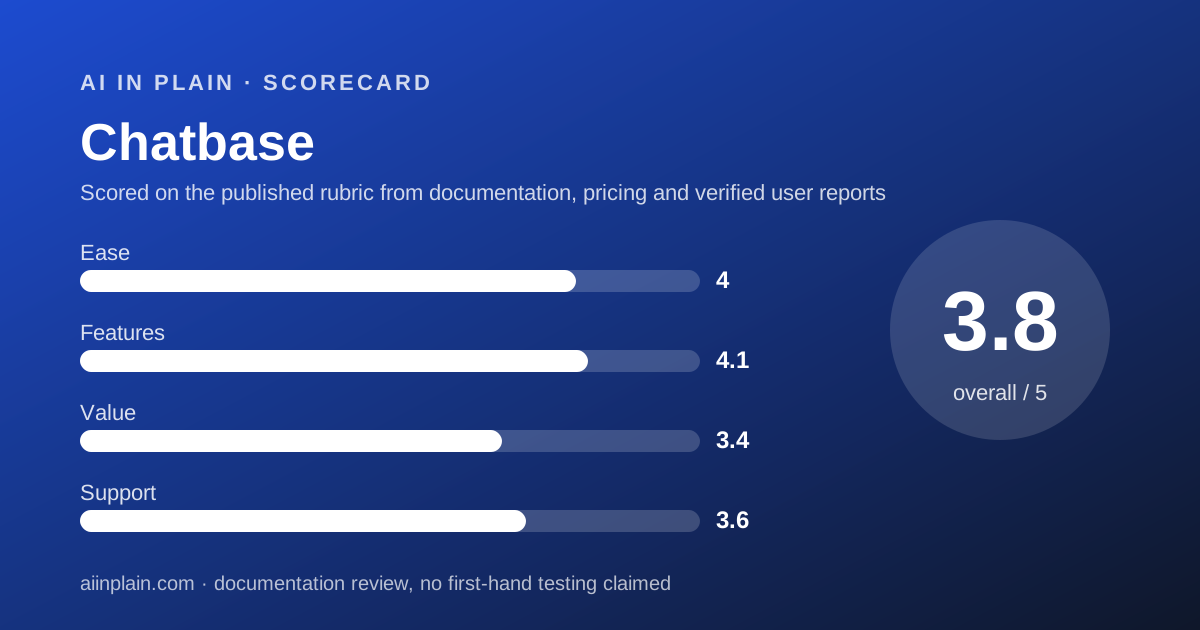
The 4.0 is graded from the documentation, which is unusually complete for a product this size. There is a published index at /docs/llms.txt and a plain text version of most pages.
Setting up an agent means attaching sources and writing instructions. The documentation says the uploader shows the extracted data size of your documents, which is how you check yourself against the 40 MB ceiling.
Writing those instructions is the part most people rush. Our guide on writing a prompt that gets a usable first draft covers the same discipline, and how to ask an AI tool for what you want is the shorter version.
Features: what each plan unlocks
The comparison table is honest about how thin Hobby is. The cheapest plan is a widget on your own site and little else.
- AI Actions per agent: 5 on Hobby, 8 on Basic, 12 on Business
- Procedures per agent: 2, 4 and 6 respectively
- Test credits: 200, 500 and 1,000 a month
- Workspace seats: 2, 3 and 5 members
- API access, voice, telephony and outbound campaigns start at Basic
- Concurrent voice calls: 10 on Basic, 20 on Business
- Advanced analytics, source suggestions and tickets as a source are Business only
Integrations split neatly in two
Hobby includes the places customers already are: Shopify, Slack, WhatsApp, Messenger, Instagram, Calendly and WordPress.
Everything a support team uses starts at Basic. That list covers Stripe, Zendesk, Salesforce, Intercom, HubSpot, Zoho Desk, Freshdesk, Freshchat, Helpscout, Gorgias, Odoo, Sunshine, Zapier and Twilio.
The model choice does not follow that split. Advanced models from OpenAI, Anthropic, Google, DeepSeek, MoonshotAI, Mistral and Z.ai are marked as included on all three self serve plans.
Value: the single agent limit decides it
On credits alone Chatbase looks fair. Basic's 4,000 credits for $150 a month works out near 3.8 cents a credit, which is our arithmetic on the page's numbers.
The single agent limit is what pulls the 3.4 value score down. One agent on Hobby, one on Basic and one on Business means growth is a $300 a year line item each time.
The 40 MB training ceiling applies the same pressure. More documentation means paying $300 a year per extra 10 MB.
For one product with one help centre, none of that bites. For an agency, it adds up quickly and quietly.
Privacy and data use, as stated by the vendor
Chatbase states that it does not use customer data to train, retrain or fine-tune any AI model, on any plan. HIPAA enabled accounts are additionally covered by a zero data retention policy.
The pricing page names GDPR, SOC 2 Type II and HIPAA, and says data is encrypted at rest and in transit. These are the vendor's own statements, not findings of ours.
An agent can be kept private or made public. The FAQ notes that a public agent is open to anyone with the link, which is worth knowing before you share a test URL.
Support and what Enterprise changes
The self serve plans do not publish a support channel or response time, which is why the support score sits at 3.6 rather than higher.
Enterprise is where the support language appears: priority support, a success manager and SLAs. It also adds SSO, audit logs, custom roles, white labelling and higher limits.
Enterprise pricing is described as a commitment to message credits, conversations or resolutions. In other words the unit itself is negotiable at that level, which is unusual and useful.
What we could not read on October 25, 2026
The documentation URL pattern changed at some point, and several deep links in older write-ups now return a 404 page. The published index at /docs/llms.txt is the reliable route in.
No support response time is published for the self serve plans, and no Enterprise list price exists to quote. Aggregate scores on G2 and Capterra were not reachable from this machine that day, so no user rating appears here.
The numbers the vendor chooses to publish
The pricing page carries a customer banner reading Trusted by 10,000+ brands, plus three case study tiles. All of these are the vendor's own claims.
One tile credits Sandbox VR with 93% resolution accuracy and more than 1,000 questions resolved per week across 90 locations. Another credits Arcadis with 100% officially sourced answers.
The third is the most instructive for buyers. It describes Thotis Media guiding seven million students a year with a constellation of 18 AI agents.
Eighteen agents is seventeen more than any self serve plan includes. Read that tile as a picture of Enterprise, not of the $40 plan on the same page.
Alternatives, and when to choose them instead
Tidio bundles a human inbox with an AI agent and meters them separately. Choose Tidio if you need somewhere for people to reply and can forecast your volume.
Crisp charges a flat price per workspace with no conversation cap and includes a small AI allowance. Choose Crisp if one predictable invoice matters more than a tunable credit meter.
Otherwise choose Chatbase when the agent itself is the product you are buying, and the humans already have a home elsewhere.
Check the answers, then plan the exit
An agent trained on your own content still invents things. Our guide on checking an AI answer before you pass it on is the habit to build during the trial week.
If the help centre itself is the weak link, fix that first. Our AI writing assistants guide, the Wordtune review and our Grammarly against ProWritingAid comparison cover that layer.
And before you upload a document library, read how to get your data out before you cancel.
Bottom line
Chatbase is a clean, well documented way to put one trained agent in front of one product. The credit maths is published, which is more than most rivals manage.
It stops making sense the moment you need a second agent, a bigger knowledge base or a place for humans to reply. Price those three things before you sign.
Buy it if
- You need one agent answering from your own documents and nothing more
- You already run a help desk for humans and want only the AI layer in front of it
- You want a stated per model credit cost so you can size the plan honestly
- You need SOC 2 Type II or HIPAA language on the vendor side
Skip it if
- You need more than one agent, because each extra one is $300 a year
- You want a shared inbox for human replies in the same subscription
- You plan to feed it a large document library, since 40 MB is the ceiling per agent
Frequently asked
Is there a free Chatbase plan?
No. The pricing page lists no free tier as of October 25, 2026. Each paid self serve plan starts with a 7 day trial, and the cheapest is Hobby at $40 a month, or $32 a month billed yearly.
How many message credits does one reply use?
Between one and five, depending on the model. The documentation lists one credit for Auto, GPT-6 Luna and Claude 5.5 Haiku, two for models such as Claude 5.5 Sonnet, four for GPT-5.5 and five for Claude 5.5 Opus.
How many conversations does the Hobby plan cover?
Hobby includes 700 message credits a month. That is 700 agent replies on a one credit model, or 140 replies on a five credit model. The page does not translate credits into conversations.
Do unused credits roll over?
Subscription credits do not. They renew at the start of each calendar month and anything unused is lost, per the published FAQ. Auto-recharge credits bought at $40 per 1,000 do not expire.
How many AI agents can I build?
One, on all three self serve plans, per the comparison table checked October 25, 2026. Extra agents are sold as an add-on at $300 per agent per year.
Does Chatbase train its models on my data?
The vendor states that it does not use customer data to train, retrain or fine-tune any model, on any plan, and that HIPAA enabled accounts are covered by zero data retention. That is the vendor's statement.
How much content can one agent learn from?
40 MB of extracted text per agent on Hobby, Basic and Business. The extra storage add-on allows up to 40 MB more in 10 MB increments, priced at $300 per 10 MB per year.
Sources
- Chatbase pricing page, with the plan price catalogue and FAQ read from the page HTML - checked October 25, 2026
- Chatbase documentation: models comparison and credits per message - checked October 25, 2026
- Chatbase documentation FAQ: message credits, renewal and limits - checked October 25, 2026
Update history
- October 25, 2026 - First publication. Prices confirmed against the page cards, the price catalogue in the page HTML and the structured data block.
Visit Chatbase
We have no affiliate relationship with this vendor. Link goes to the official site.