Tidio vs Crisp: metered or flat for a small site
Both put a chat widget and an AI agent on a small website, and they charge in opposite directions. Tidio meters answered conversations and sells AI on a second ladder. Crisp charges one flat fee per workspace, does not cap conversations, and includes a dollar allowance of AI credits. Every number below was read from each vendor's pricing page HTML on October 25, 2026, not from a search snippet. Where we did arithmetic on published figures, we say so. On those figures Crisp wins for most small sites, and the margin is not close once AI is involved. Tidio still wins one specific case, and it is spelled out below.
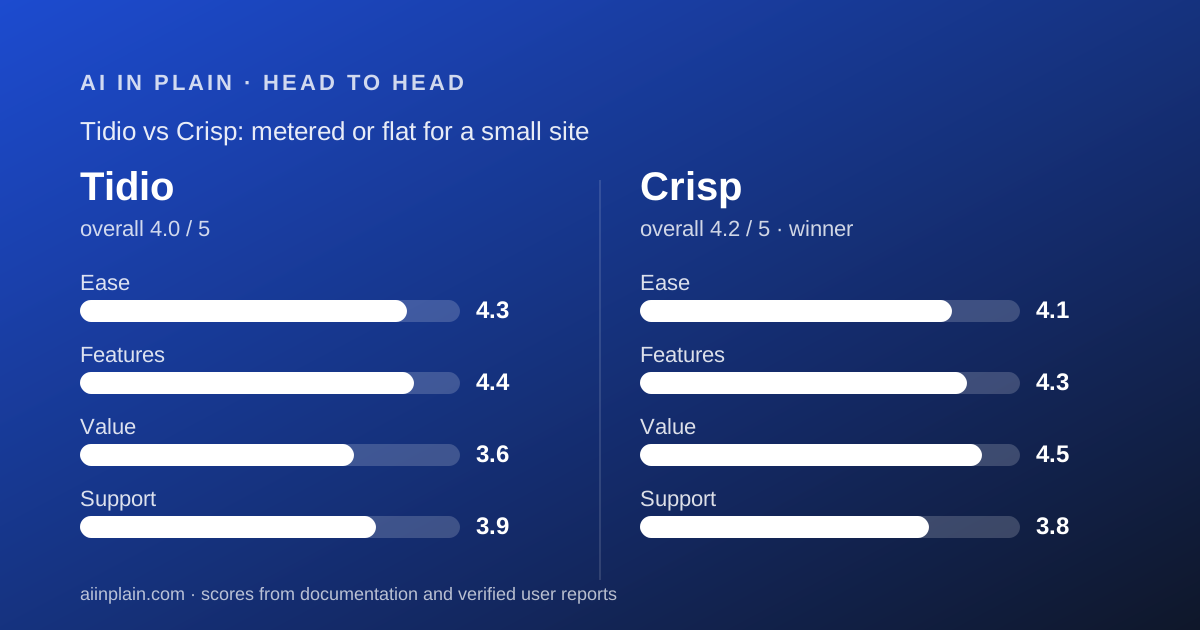
 4.0Tidio
 4.2Crisp
The short answer
One sentence each, before the detail.
- Tidio is best for a site that answers under 100 chats a month itself and does not want AI yet, because Starter is $29 against Crisp's $45
- Crisp is best for almost everything else, because unlimited conversations plus bundled AI credits beat two separate meters at small scale
- Both verdicts come from documentation and pricing pages, not from running the products
Pricing: Tidio is cheaper to start, Crisp is cheaper to run
Tidio's entry plan undercuts Crisp's by $16 a month. Starter is $29 and covers 100 billable conversations with ten seats included.
Crisp's Mini is $45 a month per workspace with four seats and no conversation cap. Essentials is $95 with ten seats. Plus is $295.
Tidio's Growth plan is not one price but seven. It steps from $59 at 250 conversations through $129 at 600 to $349 at 2,000, all inside the same plan name.
That ladder is the difference in practice. Crisp has three published steps and Tidio has nine, so the second year of growth is far easier to budget on Crisp.
Full detail sits in our Tidio review and our Crisp review.
The numbers side by side, as of October 2026
Read from both pricing pages on October 25, 2026. Prices are monthly unless marked.
- Entry paid plan: Tidio Starter $29 · Crisp Mini $45
- Mid plan: Tidio Growth from $59 (250 conversations) · Crisp Essentials $95
- Top published plan: Tidio Plus from $300 plus usage, via sales · Crisp Plus $295, self serve
- Free plan: Tidio 50 billable conversations, 10 seats · Crisp 2 seats, 100 contacts, no AI
- Seats on the entry plan: Tidio 10 · Crisp 4
- Extra seats: Tidio capped at 10 on self serve · Crisp $10 per agent per month
- Conversation cap: Tidio metered by billable conversation · Crisp none stated
- AI included in the entry plan: Tidio 50 one-off conversations · Crisp $5 of credits
- AI add-on: Tidio from $39 a month for 50 conversations · Crisp top-up rate not published
- Trial: Tidio 7 days, no card · Crisp 14 days, no card
- Annual discount: Tidio labelled 2 months free · Crisp yearly billing available, no figure printed
- Data hosting: Tidio not stated on the pricing page · Crisp European servers
Conversation limits: Tidio counts them, Crisp refuses to
Tidio's unit is the billable conversation. Per its pricing FAQ, a thread only becomes billable when a human on your side replies or starts it.
That definition is more generous than it first looks. Spam you ignore costs nothing, a thread with forty messages counts once, and replies from Lyro or Flows are not agent replies.
Crisp does not count at all. Its FAQ makes the refusal a position, arguing that consumption billing belongs to the past and that unlimited plans are peace of mind at month end.
For a site with steady volume, Tidio's definition is workable and cheap. For a site that runs promotions, Crisp removes the question entirely.
Seats: Tidio bundles more, Crisp sells more
Tidio includes ten seats on Free, Starter and Growth. Its FAQ confirms ten agents on all self serve plans, with custom counts only on Plus.
Crisp includes two seats on Free, four on Mini, ten on Essentials and twenty or more on Plus. Extra agents are a published $10 a month each.
So Tidio is the better deal for a team of six to ten on a cheap plan. Crisp is the better deal past ten, because Tidio's self serve ceiling forces a conversation with sales.
Crisp's own FAQ notes that more than twenty agents sits outside the standard plans too.
AI pricing: this is where the gap opens
Tidio sells its Lyro agent on a conversation ladder. It runs $39 for 50 AI conversations a month, $75 for 100, $140 for 200, $210 for 300 and $350 for 500.
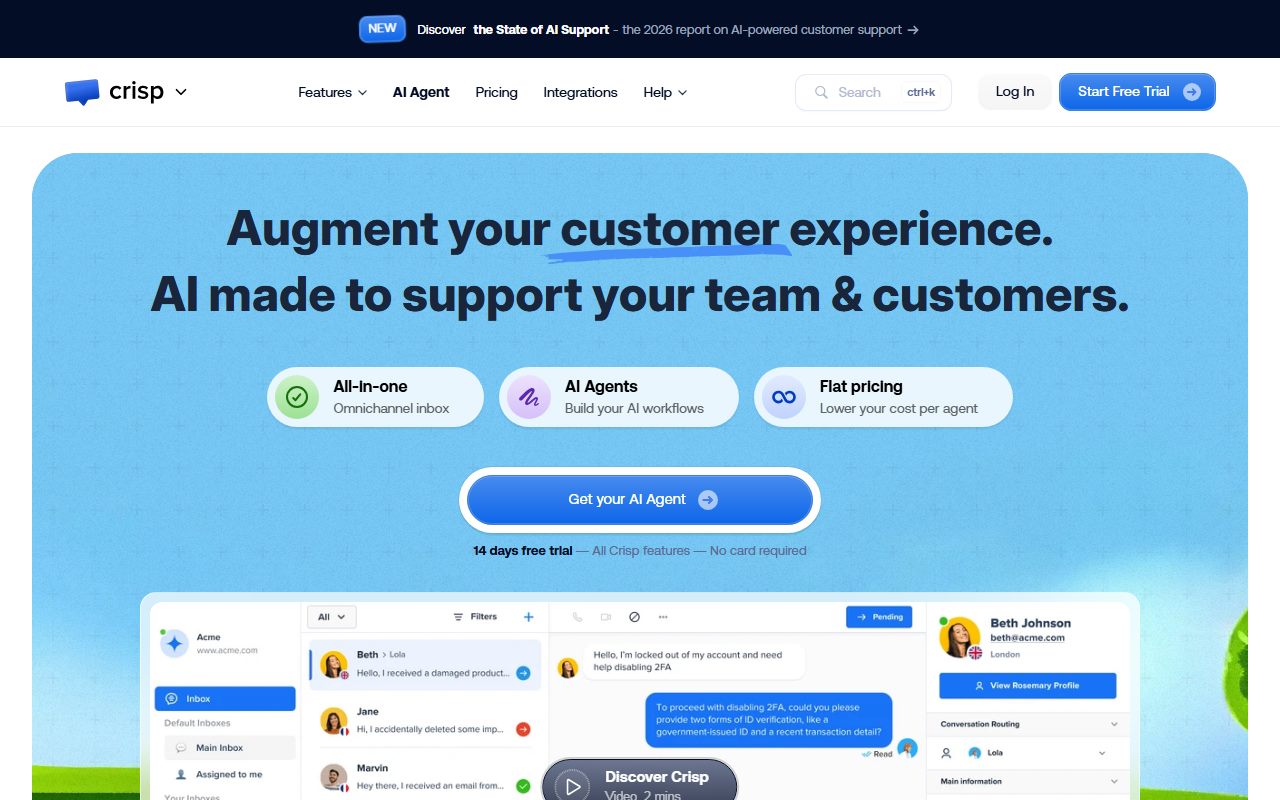
Crisp bundles a dollar balance instead: $5 of credits on Mini, $25 on Essentials, $75 on Plus. Next to each, the page estimates around 90, 450 and 1,350 automated conversations.
Put those two sets of published figures next to each other and the difference is startling. Around 450 automated conversations is included in Crisp's $95 plan; 500 Lyro conversations costs $350 on top of a Tidio plan.
Two caveats, both important. Crisp's conversation counts are approximations against a credit balance, so a verbose model will burn them faster. Tidio's numbers are a hard allowance, which is less flexible but entirely predictable.
The gap is wide enough that it should decide the purchase, and wide enough that you should verify it on your own traffic during the trials.
Three worked examples on the published ladders
The arithmetic below is ours, using each vendor's own published prices on October 25, 2026. Taxes are excluded, and Crisp states that VAT is not included in its list prices.
- 80 human chats a month, no AI: Tidio Starter $29 · Crisp Mini $45. Tidio wins by $16
- 80 human chats plus around 90 AI conversations: Tidio Starter $29 plus Lyro 100 at $75, so $104 · Crisp Mini $45 including its $5 credit estimate. Crisp wins by $59
- 600 human chats plus around 450 AI conversations: Tidio Growth at 600 for $129 plus Lyro 500 at $350, so $479 · Crisp Essentials $95. Crisp wins by $384
Channels: Tidio opens them early, Crisp charges for them
Tidio lists Messenger, Instagram, WhatsApp and email on its social channels row from the free plan upward. That is unusually early.
Crisp keeps the omnichannel inbox for Essentials at $95. WhatsApp Business, Instagram DMs, SMS, Line and Viber all sit behind that step.
Crisp also limits channels per workspace: one Instagram, one Messenger, one WhatsApp number, one Viber, one Line, one Telegram. Email is the exception.
If social channels are your main inbox and your budget is $45, Tidio is the honest answer here.
Automation: two rule builders, two AI agents
Tidio splits automation in two. Flows follows paths you draw and triggers on visitor behaviour, which makes it a conversion tool. Lyro reads your content and interprets questions.
Flows is a third meter, running from $29 for 2,000 visitors reached to $299 for 100,000. On the free plan it reaches 100 visitors a month.
Crisp puts its workflow automation builder inside Essentials and its unlimited task automations inside Plus. There is no separate meter.
So Tidio gives you more granular control at a price per unit, and Crisp gives you fewer knobs inside a flat fee.
Either way the instructions decide the quality. Our guide on writing a prompt that gets a usable first draft applies to agent instructions almost unchanged.
The shorter version is how to ask an AI tool for what you want.
Model control: Crisp publishes it, Tidio does not
Crisp's knowledge base documents model selection in detail. Hugo can pick automatically, and the current auto-selected model is named as GPT-5.6 Luna from OpenAI.
Manual selection covers OpenAI, Anthropic, Google, Mistral and a Crisp hosted model, with a processing region setting and a built-in fallback.
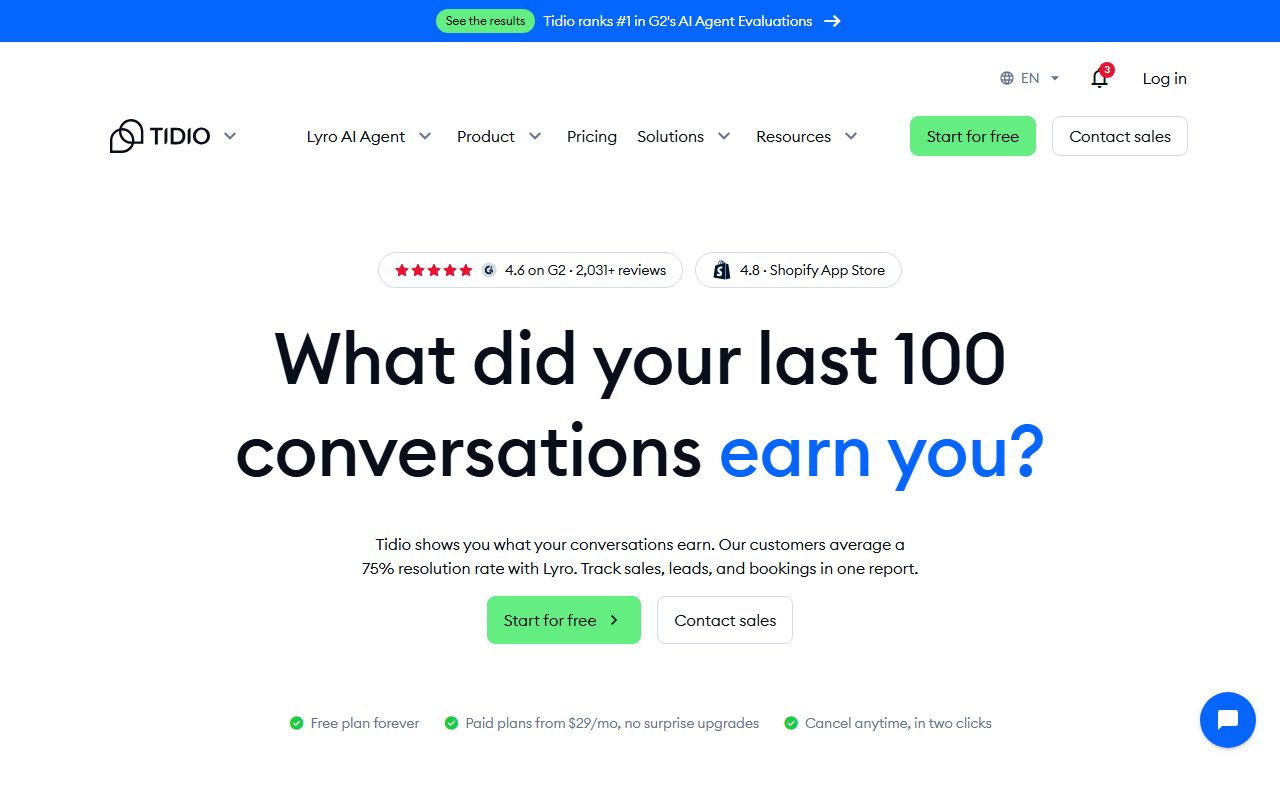
We found no equivalent public page naming the models behind Lyro. Tidio publishes resolution rates instead, stating that its customers average 75%.
That is a difference in disclosure rather than capability, and it matters if your compliance policy names providers or regions.
Whichever you choose, read the answers before customers do. Our guide on checking an AI answer before you pass it on is the five minute version.
Beyond chat: help centre, status page and tickets
Crisp bundles more surrounding products than its price suggests. A help centre with its own custom domain, sitemap and SEO metadata is part of the suite, as is a public status page.
Tidio's extras point at selling rather than publishing. Its ticketing system turns email, chat and social messages into tickets and groups them by customer intent.
Crisp's feature table also lists co-browsing, instant translation across more than fifty languages, live typing preview and audio or video chat.
Tidio's list is narrower but better aimed at a shop: a live visitors list, viewed pages history, product recommendations and operating hours.
Neither set decides the purchase today. They decide whether you need a second tool next year.
Installation and the practical bits
Both are one script in the page. Crisp documents a custom website install plus dedicated routes for CMS and ecommerce platforms, and exposes a JavaScript SDK for opening the widget from your own button.
Tidio publishes platform specific routes too, with Shopify and WordPress called out on its integrations menu.
One Tidio limit is worth repeating because it catches multi brand owners. The widget's appearance and behaviour settings are shared across every site you install it on, per its pricing FAQ.
Crisp handles the same problem by billing per workspace. Subdomains sit inside one subscription, but a genuinely separate brand needs its own workspace.
That is partly covered by Crisp's published discount of 20% for three additional workspaces, on Essentials and Plus only.
Choose Tidio if, choose Crisp if
The honest split, stated as conditions rather than preferences.
- Choose Tidio if you answer under 100 chats a month and want the cheapest paid plan
- Choose Tidio if you need six to ten seats at $29, or social channels on a tiny budget
- Choose Tidio if you want to buy an AI agent alone and keep your existing help desk
- Choose Crisp if your volume is unpredictable and a surprise invoice is unacceptable
- Choose Crisp if you want AI answers included rather than bought on a second ladder
- Choose Crisp if you need EU hosted data and a data processing agreement named up front
- Choose Crisp if you are a nonprofit or student, since the FAQ offers 50% off on request
Where Chatbase fits instead of either
Neither of these is the right answer if you only want the AI layer. Chatbase sells one trained agent metered in message credits and has no shared inbox at all.
Its cheapest plan is $40 a month for 700 message credits, and the credit cost per reply varies from one to five depending on the model you pick.
That suits a site whose humans already live in a help desk they like. Our Chatbase review sets out the single agent limit and the 40 MB training ceiling.
Whichever you pick, the AI answers from your help centre, so the help centre decides the answers. Our AI writing assistants guide covers that layer.
What we could not read on October 25, 2026
Crisp does not publish its AI credit rate on the pricing page, nor in the billing and AI Agent categories of its knowledge base. The per conversation figures used above are our own division of its dollar allowances by its own conversation estimates.
Crisp also prints no annual discount percentage, only that yearly billing can be switched on in the app.
Tidio's Premium card says Contact for pricing, so no list price exists for that tier. We also found no published per message cost for Lyro, only the per conversation ladder.
Aggregate review scores on G2 and Capterra were not reachable from this machine that day, so neither product carries a user rating in this comparison.
Bottom line
Crisp takes this on its own published numbers. Flat pricing, bundled seats, no conversation cap and an included AI allowance remove most of the ways a small support bill goes wrong.
Tidio keeps one clear win: $29 a month with ten seats, for a site that answers its own chats and is not ready for AI. That is a real segment and Tidio owns it.
Start both trials in the same week, since one runs 7 days and the other 14. Then read how to get your data out before you cancel before you commit to either.
Frequently asked
Which is cheaper for a 10 person support team?
Tidio, on seats alone: ten are included on Starter at $29 a month. Crisp needs Essentials at $95 for ten agents, or Mini at $45 plus six extra agents at $10 each, which is $105.
Which is cheaper once you want AI answering customers?
Crisp, by a wide margin on published figures. Its $95 Essentials plan includes $25 of credits, estimated at around 450 automated conversations. Tidio charges $350 for 500 Lyro conversations on top of a plan.
Does Tidio really not charge for unanswered chats?
Correct, per its pricing FAQ. A thread becomes billable only when a human agent replies or starts it, and replies from Lyro or Flows do not count as agent replies. One thread counts once.
Can I switch from Tidio to Crisp later?
Both are a script on your site, so the widget swap is quick. The conversation history is the hard part, so export it first. Our guide on getting your data out before you cancel covers the order of operations.
Which has the longer free trial?
Crisp, at 14 days with all features and no card required. Tidio runs 7 days, also with no card, and then drops the account to its free plan unless you upgrade.
Sources
- Tidio pricing page, plan and add-on catalogue read from the page HTML - checked October 25, 2026
- Crisp pricing page, plan cards and comparison table read from the page HTML - checked October 25, 2026
- Crisp knowledge base: how to choose and configure Hugo's AI model - checked October 25, 2026
- Tidio AI agent product page, resolution rate claims - checked October 25, 2026
Visit Tidio
We have no affiliate relationship with this vendor. Link goes to the official site.
Visit Crisp
We have no affiliate relationship with this vendor. Link goes to the official site.