
Listnr AI
A credit-metered voice studio with podcast hosting, video tools and a plain four-tier price list
Scored on the published rubric, from documentation, pricing and verified user reports.
Best for: Solo creators and small agencies who want hours of voiceover, storage and video tools on one cheap monthly bill.
Verdict
Listnr sells voice generation in credits, with four tiers and no hidden add-on ladder. That makes it the easiest of the three voice studios graded here to quote.
Individual is $19 a month for 20,000 credits, Solo is $39 for 50,000 and Agency is $99 for 250,000. Yearly billing charges ten months up front.
The credit figures come with an hours translation printed on the same card: roughly two, five and twenty-five hours of voice generation a month.
Storage and a monthly video allowance are bundled in, which the other two studios do not do. Commercial rights are on every paid plan.
This is a documentation review. Every figure was read from the pricing page HTML on October 29, 2026. No paid account was opened.
Visit Listnr AI
We have no affiliate relationship with this vendor. Link goes to the official site.
Where it is strong
- Four tiers, one unit, no separate add-on ladder to quote alongside the plan
- Each card prints credits and the equivalent hours of voice generation side by side
- Yearly billing is ten months up front, and every annual figure on the page matches that rule
- Commercial rights, unlimited downloads and unlimited audio embeds start at the $19 tier
- Storage and a monthly video allowance are included rather than sold separately
- The free tier gives 1,000 credits with no card and access to the studio
Where it falls short
- The page contradicts itself on voice and language counts, giving two different figures
- Running out of credits stops generation until the cycle resets or you buy more
- The page states it generally does not refund partial months or used quota
- Several comparison table rows are drawn as icons with no readable label, so plan coverage is unclear
- No published support service levels; priority support is a table row rather than a stated response time
At a glance
| Starting price | $19/mo (Individual, 20,000 credits a month) |
|---|---|
| Pricing note | From $19/mo for 20,000 credits a month, or $190 a year billed up front (pricing page HTML, checked October 29, 2026) |
| Free plan | Yes, 1,000 credits to start, studio access, no card required |
| Annual billing | Ten months up front: $190, $390 and $990 a year on the three paid tiers |
| Credit allowance | 20,000 on Individual, 50,000 on Solo, 250,000 on Agency, per month |
| Hours implied | About 2, 5 and 25 hours of voice generation a month, per the plan cards |
| Storage | 50GB on Individual, 100GB on Solo, 250GB on Agency |
| Video allowance | 50, 150 and 250 videos a month across the three paid tiers |
| Commercial rights | Included on Individual, Solo and Agency, per the pricing FAQ |
What Listnr actually sells
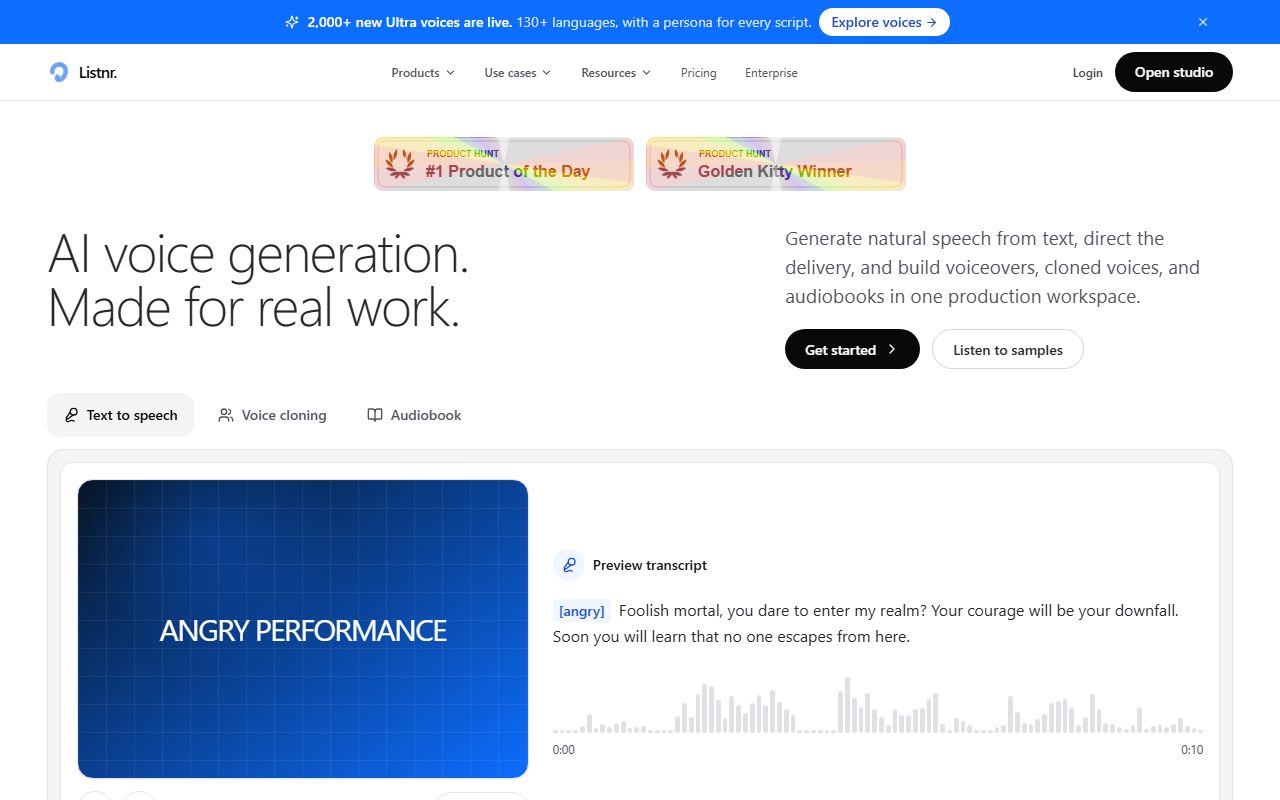
Listnr is a voice studio with a wider skirt than most. The product menu lists text to speech, translation, voice cloning, a text to speech API and a podcast studio.
The pricing page sells all of that through one unit: credits. There is no separate ladder for the API or for cloning.
Around the core sit video features, counted as a monthly video allowance, and storage, counted in gigabytes. Both are bundled into the plan rather than billed apart.
That packaging is the real difference. Most voice tools sell minutes or characters and nothing else. Listnr sells a small production account.
Who Listnr is best for
Listnr suits the creator whose bottleneck is budget rather than feature depth, and who wants fewer invoices rather than better ones.
- Solo video creators producing YouTube explainers and social clips every week
- Audiobook narrators who need many hours of generation at a low monthly rate
- Small agencies handling client voiceovers across several languages
- Podcasters who want generation and hosting in the same account
- Anyone who needs commercial rights on a $19 plan rather than a $160 one
- Teams who prefer counting credits to forecasting generation hours a year
Who should skip it
Three groups will find the model or the documentation gets in the way.
- Producers with unpredictable spikes, because an empty quota blocks generation entirely
- Buyers who need a contractual support response time in writing
- Procurement teams who need every plan boundary stated in text rather than drawn as a tick
What the free tier includes, as of October 2026
The free card lists $0 a month, 1,000 credits to start and no credit card. It is an evaluation account rather than an ongoing free plan.
The card also lists studio access and the ability to preview the voice library. Downloads and exports are marked Limited in the comparison table.
Voice generation on free is labelled Starter in the same table, against roughly two hours on Individual. So the free tier is sized to let you hear a voice, not ship a project.
Note the word to start. The 1,000 credits are an opening balance, and the page does not say they refresh monthly.
How the pricing is structured
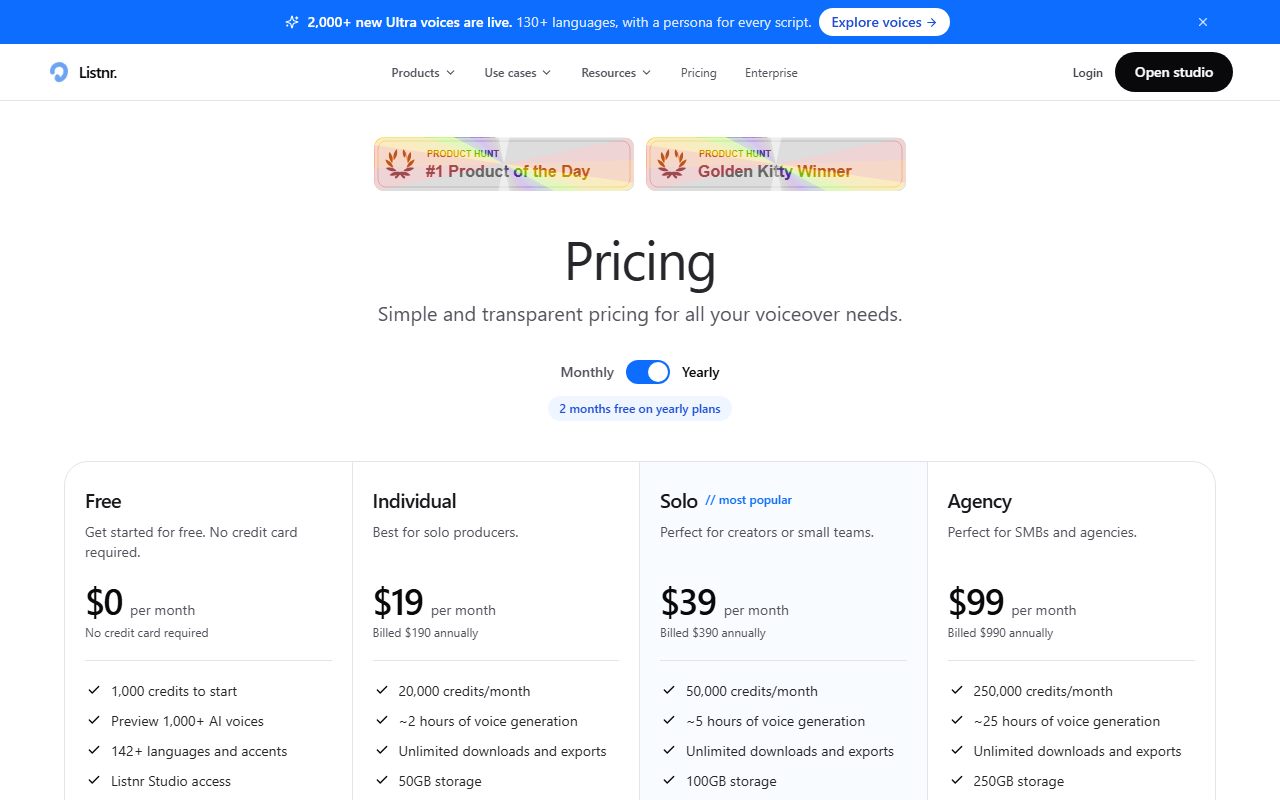
Every figure below was read from the pricing page HTML on October 29, 2026, with the toggle in its monthly position.
Individual is $19 a month, billed $190 annually. Solo is $39 a month, billed $390 annually. Agency is $99 a month, billed $990 annually.
The toggle is labelled two months free on yearly plans, and the pricing FAQ states that yearly billing charges ten months up front.
All three annual figures match that rule exactly: ten times $19 is $190, ten times $39 is $390, ten times $99 is $990. That check is ours.
Above Agency the page offers custom pricing through a contact form, with seat-based licences, dedicated API throughput and volume pricing listed as features rather than priced.
The credit to hours translation is printed on the card
Credits are a meaningless unit until a vendor tells you what one buys, and Listnr does tell you on the same card.
Individual lists 20,000 credits a month and roughly two hours of voice generation. Solo lists 50,000 credits and roughly five hours. Agency lists 250,000 credits and roughly twenty-five hours.
Those three ratios are consistent: about 10,000 credits per hour of audio on every tier. That division is ours, not a figure Listnr publishes.
The practical reading is a per-hour price. Individual works out near $9.50 an hour of generation, Solo near $7.80 and Agency near $3.96, again our arithmetic on the published figures.
Agency is therefore the only tier that gets genuinely cheap per hour, which is worth knowing before you pick the middle plan by instinct.
What each tier adds on top
The steps between tiers are mostly about volume, storage and video output rather than studio capability.
- Individual: 20,000 credits, 50GB storage, 50 videos a month, unlimited downloads and exports
- Individual: access to all 1,000 or more voices, unlimited audio embeds, commercial rights
- Solo: 50,000 credits, 100GB storage, 150 videos a month, marked most popular on the page
- Agency: 250,000 credits, 250GB storage, 250 videos a month
- Custom tier: seat-based licences, custom credit volumes, dedicated API throughput, SSO and invoicing
- Custom tier: onboarding and training, a service agreement and priority feature access
The page disagrees with itself on voices and languages
Two sets of numbers appear on the same page, and a buyer should see both rather than whichever one loads first.
The banner across the top reads 2,000 or more new Ultra voices are live, across 130 or more languages.
The plan cards and the comparison table say 1,000 or more voices and 142 or more languages and accents.
Both were read from the same page HTML on October 29, 2026. The library and the plan entitlement may be different things, but the page does not say so.
Confirm the figure that matters to you at the checkout step or with support before committing to an annual plan. Do not treat either number as settled.
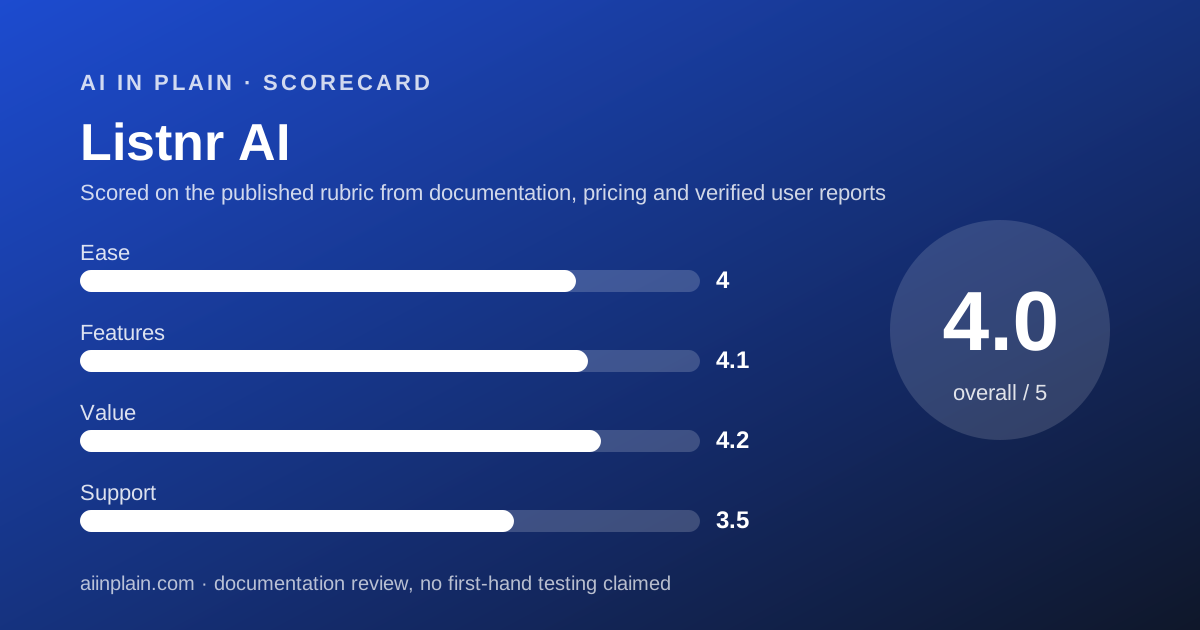
Ease of use: what the 4.0 is built from
The score covers how easily a buyer can quote the product and get to an export, graded from the published pages.
Quoting is the strong half. One unit, four tiers, an hours translation on the card and an annual rule that checks out.
The documentation is the weak half. Several comparison table rows, including voice cloning, priority support and custom invoicing, carry no readable value for each plan.
Those cells are drawn as icons without text labels, so this review does not state which tiers include them. Guessing from column position is how buyers end up with the wrong plan.
Features: broad for the money
On published breadth Listnr sits between the other two voice studios graded here, and it covers ground neither of them does.
Translation, voice cloning and a podcast studio are listed as products. A video side exists too, with reels, subtitle and text to video generators listed in the footer.
Storage is the quiet differentiator. 50GB at the $19 tier means finished audio and video can live in the account rather than on your drive.
For scripting the narration in the first place, our guide on writing a prompt that gets a usable first draft is the step before any of this.
If the clip is destined for short social video, our Opus Clip review and our Descript review cover the cutting layer.
Value: the strongest column, with one condition
Listnr is the cheapest published route to commercial-rights voiceover among the three studios graded here, and the 4.2 score reflects that.
The condition is forecasting. The pricing FAQ is explicit: run out of credits and you cannot generate new audio until the quota resets or you buy more.
There is no overage grace. Extra credits are bought inside the studio, or you upgrade a tier.
Compare that with WellSaid Labs, where generation is unlimited and only downloaded minutes count against the plan. That meter forgives a bad forecast; this one does not.
Billing rules and the limits the vendor states
The pricing FAQ answers more than most, and the answers are specific enough to plan around.
- Upgrades typically apply the new quota immediately, with the prorated difference calculated automatically
- Downgrades take effect at the end of the current billing cycle, not on the day
- Cancelling reverts the account to the free tier at the end of the paid period
- Payment is by Visa, Mastercard, American Express or PayPal; enterprise can use invoicing and wire transfer
- The page states it generally does not refund partial months or used quota
- Invoices are emailed automatically and can be downloaded from billing history in the studio
Support: the weakest column
The 3.5 support score is about what is published, not about any experience of the queue.
Priority support appears as a row in the comparison table with no stated response time, and no support hours appear on the pricing page.
The custom tier lists onboarding, training and a service agreement, which implies service levels exist above the self serve plans. None are quoted.
For contrast, WellSaid Labs publishes a one business day email target and a four hour chat target. That is the gap this score measures.
What the vendor displays about itself
The page carries a G2 Users Love Us badge and four short customer summaries attributed to named G2 reviewers by first name and role.
No aggregate rating number appears beside the badge, and the G2 profile itself was not reachable from this machine on October 29, 2026.
So no independent rating is quoted in this review. The badge is a vendor-displayed graphic rather than a verified score.
Before you let any generated narration go out unchecked, read it against the source script. Our guide on checking an AI answer before you pass it on is the short version of that habit.
Alternatives, and when to choose them instead
Murf AI lists 200 or more voices across 30 or more languages, and sells 24 hours of generation a year on its entry plan.
Choose Murf if you want dubbing, transcription and a per-character speech API on one account, and one editor seat is enough.
WellSaid Labs bills only the minutes you download and leaves generation unlimited. Choose WellSaid if you audition heavily in English and want published support service levels.
Otherwise choose Listnr when the monthly number matters most and your volume is predictable enough to stay inside the credits.
Plan the exit before you commit
A credit account with 50GB of your finished audio in it is easy to join and awkward to leave.
Read our guide on getting your data out before you cancel while the free tier is still open to you.
If the voiceover accompanies recorded meetings or interviews, the transcript side has its own tools. Our AI meeting note takers guide and our Fireflies.ai review cover that.
For how the narration fits into a finished edit, see Descript versus Opus Clip. And for the voice tool most people name first, see our note on ElevenLabs.
Bottom line
Listnr is the right call for a creator or small agency that wants hours of commercial voiceover, storage and video output on one cheap monthly bill.
It is the wrong call if your volume is unpredictable, if you need a written support target, or if you need every plan boundary stated in words.
Buy it if
- You want one monthly number covering voice, storage and video output
- You produce steady volume and can forecast roughly how many hours you need
- You need commercial rights cheaply, including monetised video and audiobooks
- You want a plain four-tier list rather than a plan plus two add-on meters
Skip it if
- Your volume spikes without warning, since running dry stops generation outright
- You need a published support response time before you commit
- You want certainty on exactly which plan has voice cloning, which the table draws as an icon
Frequently asked
How much does Listnr AI cost?
Individual is $19 a month, Solo $39 and Agency $99, per the pricing page HTML checked October 29, 2026. Yearly billing charges ten months up front: $190, $390 and $990 respectively.
Is Listnr AI free?
There is a free tier with 1,000 credits to start, studio access and no credit card. Downloads and exports are marked Limited, and the page does not say the credits refresh monthly.
How many hours of audio do the credits buy?
The cards print roughly two hours for 20,000 credits, five hours for 50,000 and twenty-five hours for 250,000. That is about 10,000 credits an hour on every tier, by our arithmetic.
What happens if I run out of credits?
Generation stops. The pricing FAQ states you cannot create new audio until the quota resets at the next billing cycle, unless you buy extra credits in the studio or upgrade a tier.
Can I use Listnr audio commercially?
Yes on paid plans. The FAQ states Individual, Solo and Agency include commercial rights, naming monetised video, advertisements, audiobooks and presentations. The free tier is not listed as covered.
How many voices and languages does Listnr have?
The page gives two answers. The banner says 2,000 or more voices across 130 or more languages; the plan cards say 1,000 or more voices across 142 or more languages. Confirm before paying annually.
Does Listnr refund an unused subscription?
The pricing FAQ states it generally does not refund partial months or used quota, and asks you to contact support within the first few days of purchase if a technical issue blocks the service.
Sources
- Listnr AI pricing page, plan cards and compare plans table read from the page HTML - checked October 29, 2026
- Listnr AI pricing FAQ, on the same page: annual billing rule, quota exhaustion, refunds, payment methods - checked October 29, 2026
Update history
- October 29, 2026 - First publication. Credit tiers, annual rule and billing answers read from the pricing page HTML. Voice and language counts recorded as two conflicting on-page figures.
Visit Listnr AI
We have no affiliate relationship with this vendor. Link goes to the official site.